Exploring medieval Normandy means immersing yourself in an exceptional cultural and historical heritage, home to some of France’s most remarkable landmarks. Today, we invite you to venture beyond the usual tourist routes and discover a selection of lesser-known castles.
01
Eure
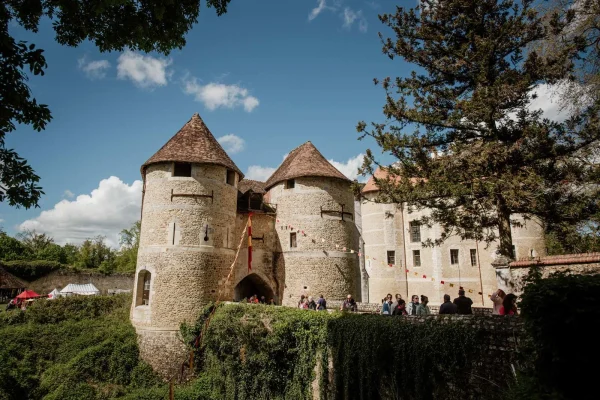
Harcourt Estate (Domaine d’Harcourt)
The western side of the castle has retained its medieval appearance from the 12th and 14th centuries, featuring double moats, a fortified outer bailey, and circular towers flanking the façade. Renovated in the 17th century, the eastern façade was fitted with large windows and its moats were filled in, transforming the fortress into the residence of the Harcourt family.
The estate is also renowned for its arboretum, which boasts an outstanding botanical collection of more than 500 species of trees and shrubs. Numerous events throughout the year bring the site to life.
02
Manche
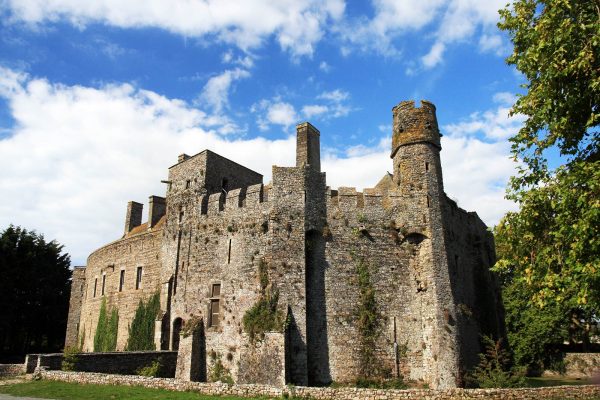
Pirou Castle
Built on an island surrounded by an artificial pond, Pirou Castle is a medieval fortress dating back to the 12th century. Its outer bailey still contains many of the buildings essential to life in a medieval castle, including a chapel, bakery, cider press, and stables.
Visitors can also admire the Pirou Tapestry, a 58-metre-long embroidery depicting the Norman conquest of Sicily and southern Italy. Another highlight is the legend of the Geese of Pirou, which tells how the castle’s inhabitants transformed themselves into geese to escape Scandinavian invaders.
03
Orne
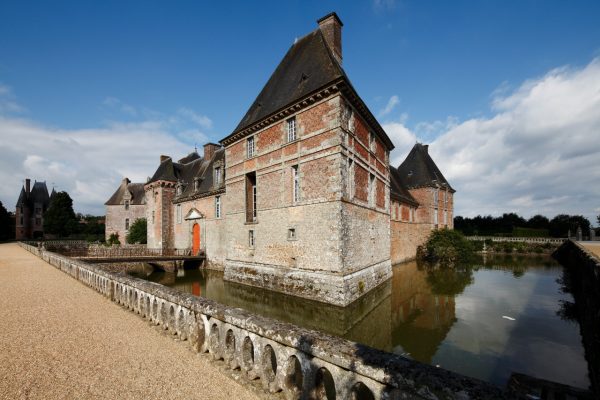
Carrouges Castle
Located in the heart of the Normandy-Maine Regional Natural Park, Carrouges Castle reflects its striking red brick, granite, and slate colours in the water-filled moat surrounding it.
Its 14th-century keep bears witness to the castle’s role as a stronghold during the Hundred Years’ War. In the 15th century, the fortress evolved into a noble residence, and two classical wings were added at the end of the 16th century.
04
Eure
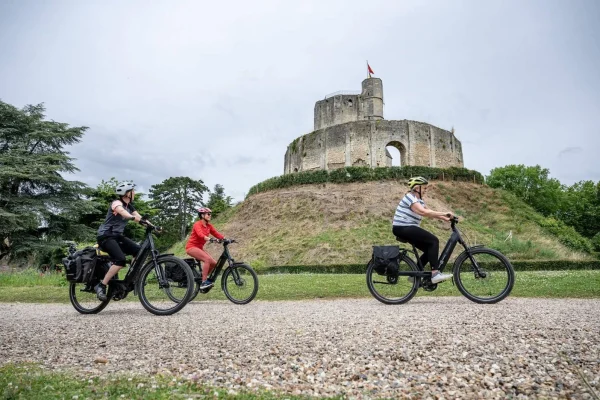
Gisors Castle
As a border town, Gisors was a strategic stronghold between the 10th and 12th centuries. A feudal motte topped by a keep was established there in the 11th century. In the 12th century, the Plantagenets enhanced the site with an octagonal stone keep and an outer bailey.
Later expanded by the Kings of France, the castle includes the famous Prisoner’s Tower, whose walls bear graffiti left by former inmates. Frequently contested, particularly during the Hundred Years’ War, the fortress finally returned to the French Crown in 1449.
05
Manche
Saint-Sauveur-le-Vicomte Fortress
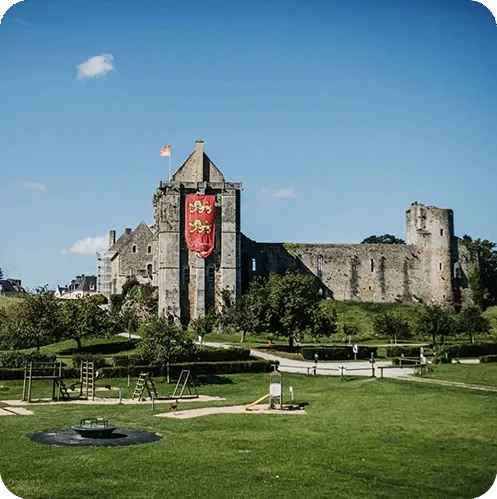
Built along the banks of the River Douve, this imposing fortress dates back to the 12th century. Twice besieged during the Hundred Years’ War, Saint-Sauveur-le-Vicomte was the scene of fierce battles.
The surviving structures, mainly dating from the 14th century, include a polygonal fortified enclosure with circular towers, an impressive square keep, residential quarters overlooking the ramparts, a former chapel, and a gatehouse framed by two massive towers.
06
Orne
The Ruins of Domfront Castle
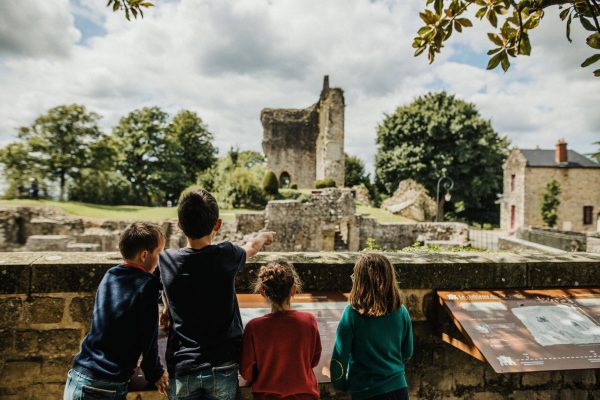
Perched on a rocky promontory, Domfront Castle once formed an impressive defensive stronghold, with its earliest fortifications dating back to the 11th century.
Over the centuries, the castle passed through the hands of numerous counts and lords, including William the Bastard, later known as William the Conqueror. Today, the remains of the castle are located in a public park and can be visited free of charge.
07
Calvados
Crèvecœur Castle
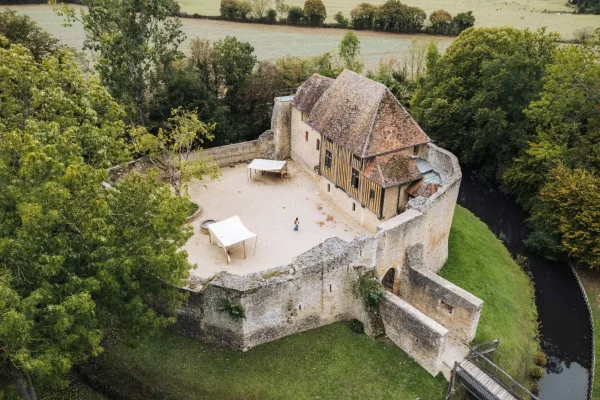
Located in Crèvecœur-en-Auge, this exceptionally well-preserved castle consists of several buildings spread across both the inner and outer baileys.
Highlights include a 12th-century chapel, timber-framed agricultural buildings, and a 15th-century manor house. Visitors can discover everyday medieval life through historical reenactments, period objects, and themed exhibitions.
08
Calvados
Colombières Castle
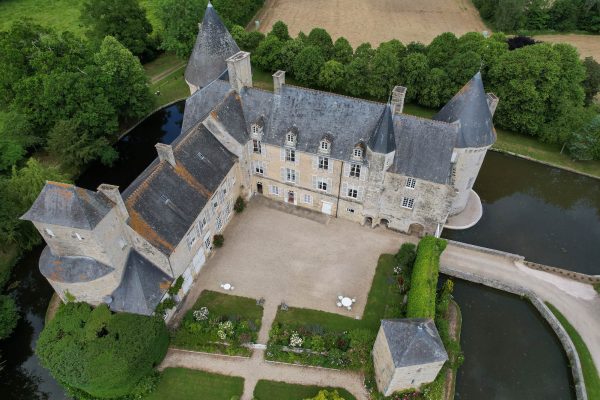
Situated in the heart of the Cotentin and Bessin Regional Natural Park, Colombières Castle reflects nearly a thousand years of history.
A fortified site was first established here in the 11th century by the de Colombières brothers, companions of William the Conqueror. At the end of the 14th century, the castle took on its current form: a quadrangular fortress flanked by four towers and protected by high machicolated walls, moats, and a drawbridge.
Today, the castle is open to visitors and even offers guest accommodation on site.
Thematics