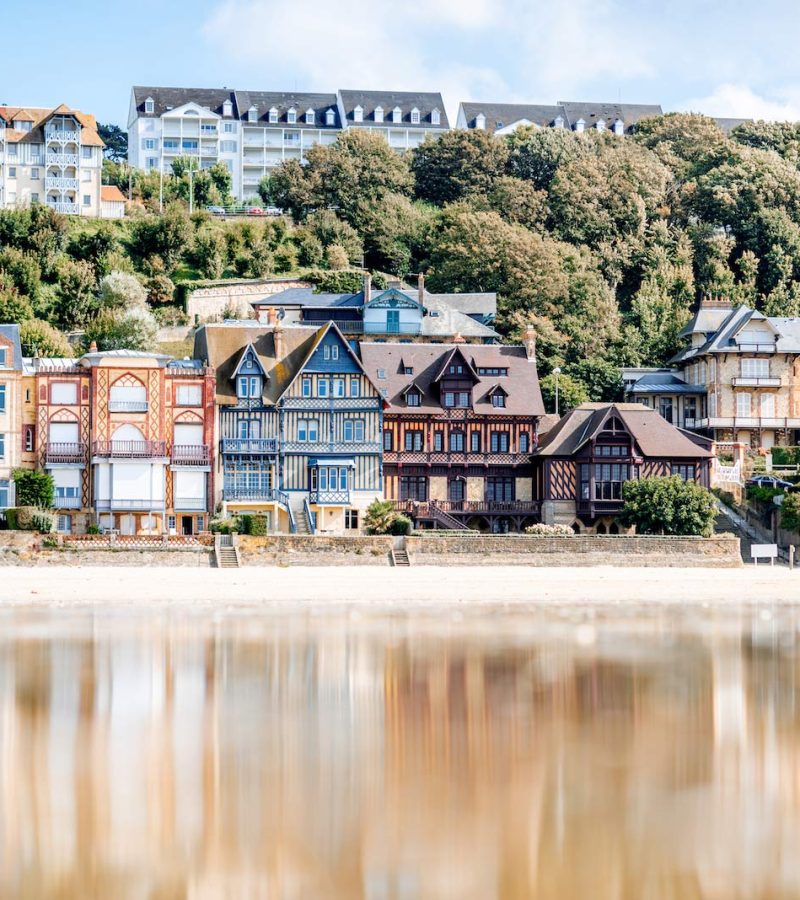

Artists and writers have long fallen for Trouville-sur-Mer, Deauville’s older sibling. This seaside resort, originally a fishing port, combines glamorous buildings and villas, a vibrant fish market, splendid sandy beach with boardwalk and many other surprises.
Why should you visit Trouville-sur-Mer?
If those French literary giants, Flaubert and Proust, approved, Trouville must have style. As to Monet and his Norman master, Boudin, they painted memorable scenes of the 19th-century bourgeoisie in their finery promenading along the broad beachfront here. In fact, Trouville was one of the first-ever coastal resorts to be developed in France. Artists may have started the trend for coming here, but by the time of Emperor Napoleon III, from the mid 19th century on, the rich and fashionable flocked to Trouville too. They ordered grand villas and palaces of entertainment, like the glitzy casino.
Trouville casino was built surprisingly close to the lively fishing port, backed by a classic covered fish market, with lively seafood restaurants all around. Scallops, sole, prawns and mackerel are traditional specialities. The lively port area draws the crowds, particularly for the Wednesday and Sunday markets. You’ll also find typical seaside shops.
Wander up the slope into the winding lanes to enjoy the calmer side of Trouville, as well as characterful 19th century architecture. Culture vultures can find their fill in the galleries around town. Back beside the sea, Trouville’s strand was declared ‘Queen of Beaches’ in the past and is still greatly appreciated by bathers and walkers today. Elating trips out to sea or relaxing thalassotherapy sea-water treatements are also on the cards here.
Things to see and do in Trouville-sur-Mer

- The fish market: This elegant building on the quays beside the fishing harbour dates back to 1925 and is a must for anyone with a penchant for fresh seafood platters washed down with crisp white wine!
- Beach and boardwalk: The wooden boardwalk along Trouville-sur-Mer’s beach dates back to 1867, making it the first boardwalk on the Normandy coast.
- Savignac murals and the Musée Villa Montebello: The acclaimed humorous poster designer Raymond Savignac, settled in Trouville-sur-Mer and became deeply attached to the seaside resort. He died in 2002. The town has honoured him with a gallery beside the tourist office. You can also see his murals dotted around the town.
- The casino: You can’t miss this grand building which sits right on the seafront and has been done up sumptuously inside by leading French designer Jacques Garcia, who has strong ties with Normandy (visit his stately home in the Eure département, the impressive Château du Champ de Bataille)
The local speciality
If there’s one place to go for seafood, it’s Trouville-sur-Mer! Come and taste oysters, mussels and all kinds of seafood. Don’t forget to visit the famous fish market which is open all year round. Did you know that Trouville is also famous for its mackerel? Artisanally caught, they are renowned for their freshness and quality.
Market days in Trouville-sur-Mer
- Weekly markets are held all year round on Wednesday and Sunday mornings from 8am to 1pm.
On Saturday mornings there is an organic market near the fish market. - The famous fish market in the Halle aux poissons in Trouville is open every day of the year and sells fish and shellfish. Tasting on the spot.
How do I get to Trouville by public transport?
- By train: Trouville-sur-Mer can be reached from Paris Saint Lazare and Lisieux stations.
- By coach: The Nomad Car network allows you to get to Trouville-sur-Mer from Caen or Le Havre with route 111 (Le Havre – Honfleur – Deauville – Cabourg – Caen).
Long-distance coaches run between Trouville-sur-Mer and several major French towns (including Paris).
- By bike: Near Trouville-sur-Mer, Deauville is crossed by the Vélomaritime, a route between Roscoff and Dunkirk, and by the Seine à Vélo, which links Paris to Le Havre and Deauville.