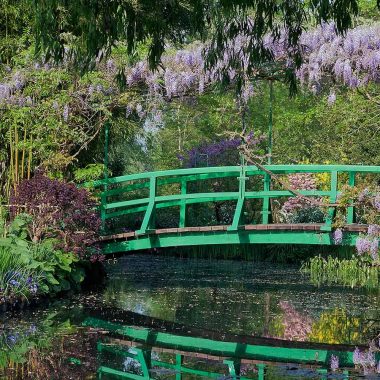
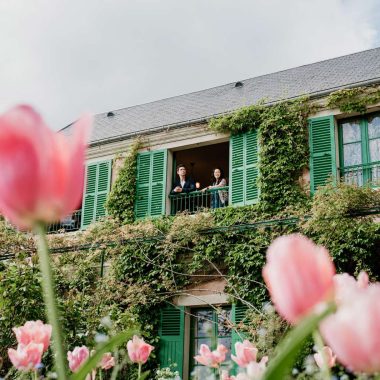
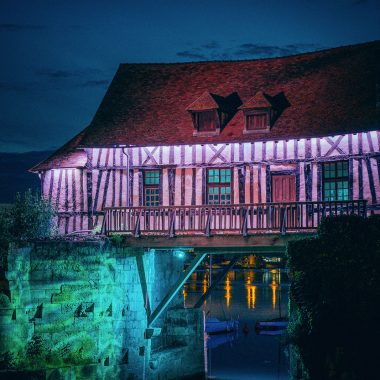
The famous water lily ponds and colourful gardens created by the Master of Impressionism, Claude Monet, at his home in Giverny, close to Paris and Rouen, gave him his greatest artistic inspiration and have made this tiny river Seine-side village famous all over the world.
An Impressionist hub
Giverny lies on the bank of the River Seine in Normandy, close to the town of Vernon. Were it not for the arrival of the renowned Impressionist painter Claude Monet in 1883, the village might have remained a quiet provincial backwater. The long years Monet spent at his house in Giverny would turn it into a place of artistic pilgrimage, even in his lifetime. He settled here with his companion Alice Hoschedé and their respective children, and lived here until his death in 1926.
Monet designed several exuberantly colourful gardens, the most ambitious of which was his famous water garden complete with lily ponds, which initially caused discontent among some local people, as it involved shifting the course of a stream. Monet was not seeking specific inspiration with this plan, but once the ponds were flourishing, they led to some of his very finest paintings – Water Lilies – a series that became beloved around the world and which put the small Normandy village of Giverny on the map. Monet had become a hugely admired artist by this time, and a ‘colony’ of followers came to visit him in Giverny, changing the face of the village. Monet lived here up until his death in 1926.
Following Monet’s death, his property gradually fell into decline. Thanks to generous donations, especially from wealthy American patron Walter Annenberg, the house and gardens were eventually beautifully restored, and have since become a magnet for huge numbers of tourists. An Impressionist art museum has also been built down the road thanks to generous American donors – highlighting Giverny’s Franco-American artistic links (American Impressionist Theodore Earl Butler became a good friend of Monet’s in Giverny, and would go on to marry two of his stepdaughters).
The picturesque village of Giverny still draws artists, art lovers and tourists alike, as you can see from its many galleries, teashops, hotels and restaurants.

Our advice
When should you visit Giverny?
Giverny is one of Normandy’s unmissable destinations. The Monet Foundation (open from April to November) is the second most visited site in the region after the Abbey of the Mont-Saint-Michel!
The ideal time of year to visit
To make the most of the village and its landmarks, we’d recommend visiting Giverny on a weekday in spring or mid-autumn. As far as opening times are concerned, late afternoons tend to be quieter in the village and gardens.
Periods to avoid
Avoid July and August if possible. But also bank holidays, weekends (in good weather) and school holidays. The busiest time is between 10am and 4pm.
How do I get to Giverny by train?
- By train: Vernon-Giverny station is 50 minutes by train from Paris Saint-Lazare station and 40 minutes by train from Rouen Rive Droite station.
The town of Vernon is just 5 km from the village of Giverny.
How do I get to Giverny from Vernon?
Catch the 100% electric shuttle bus from Vernon station (€10 return per person), usually from April to November.
By bike: Giverny is crossed by the Seine à vélo, a route linking Paris to Le Havre or Deauville. Allow around 20 minutes between Vernon and Giverny. Classic or electric bikes can be hired near Vernon-Giverny station.
On foot: allow an hour’s walk.
On foot or by bike: start at rue de la gare and follow the signs to rue d’Albufera. Continue straight ahead and cross the Clemenceau bridge. Turn right to join the Seine cycle route. Follow the path to rue Claude Monet in Giverny.
The petit train (little tourist train) from the station (8 € return per person).
Please note that some services are not available during the winter season.
- By coach: Giverny is served by line 208 of the Nomad Car network linking Gisors to Vernon.
Weekend by rail
Our ideas for your stay in Giverny and Vernon
Explore Normandy at your own pace and enjoy a more responsible holiday. You’ll also find some of our best addresses: hotels, restaurants and places to visit, all accessible without a car.