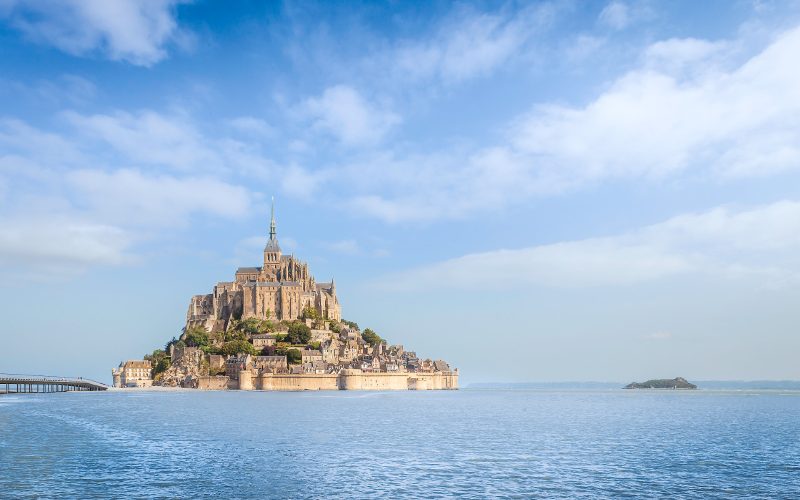
In the Bay of the Mont-Saint-Michel, it is said that the tide comes in at the speed of a galloping horse. Admittedly, this is a bit of an exaggeration, but the water does move at a speed of around 6 km/h! A impressive show to watch at high tide.
When the Mount becomes an island once again!
The Bay of Mont-Saint-Michel is home to the highest tides in continental Europe. Certain days of the year are more suitable for observing this phenomenon. As soon as the tidal range exceeds 110, the Mount becomes an island again for a few hours. The water covers the submersible ford. Access to the rock is then cut off.
Find out more about the tide times in the Bay of the Mont-Saint-Michel on the local Tourist Office website.
You are strongly advised not to venture out alone into the Bay of the Mont-Saint-Michel. Always cross the Bay with a guide.


A Normandy Experience at high tide at the Mont-Saint-Michel
Combine a fascinating tour of the abbey with a timeless night on the Mont-Saint-Michel during high tides.
The best spots
Where can you watch the high tides?
To observe the phenomenon of the rising tide and the arrival of the tidal bore, it is advisable to be on site 2 hours before high tide. Here are some of the best spots:
- The bay is an ideal vantage point: the Roche Torin in Courtils, the Grouin du Sud in Vains-Saint-Léonard and the Gué de l’Epine in Val-Saint-Père are all great spots!
- The footbridge, a fantastic location: it’s at the mouth of the rivers that you can experience the power and force of the waves.
- The ramparts and forecourt of the abbey, for a general view: the ramparts, the west terrace (forecourt of the abbey, access to which is included in the tour). On high tide days, young and old alike enjoy being there to watch the sea rise at an impressive rate. It’s an unforgettable experience!
What exactly is a tide?
The phenomenon of tides on Earth is essentially caused by the gravitational pull of the Moon. When the Moon passes over an area of ocean, a bulge forms on the surface of the sea. A wave then propagates through the oceans, creating a tide.
So why are there two high tides a day?
When the Earth and the Moon make their annual orbit around the Sun, they draw small circles. Like milk in a bowl, when you draw small circles with the bowl, a wave is created on the surface of the milk. This is because of centrifugal force. So the gravitational pull of the Moon creates the first high tide on the Earth, and the centrifugal force caused by the Earth and Moon orbiting the Sun creates the second high tide.
And what about high tides?
If the moon causes the tides, the sun also has an influence on the movement of the sea. When the Moon and Sun are aligned, their gravitational pulls add to each other to produce the great tides. When the Moon orbits the Earth at right angles to the Sun, their forces counteract each other and we have small tides.
These tides are defined by coefficients: the higher the coefficient, the higher the sea level. At a coefficient of 110, the Mont-Saint-Michel becomes an island again.
Why are equinox tides the biggest of the year?
This is because the Sun is closest to the equator on those days and its pull on the Earth is stronger. As long as the moon is also on the same axis, we can expect very high tides.
What is the tidal bore, which is visible at high tide?
In the Bay of the Mont-Saint-Michel, the tidal bore is only visible during the spring tides. It is a wave from the English Channel that covers the opposing currents of the waters of the three coastal rivers: the Couesnon, the Sélune and the Sée. This rare natural phenomenon is a magnificent spectacle of nature that experienced kayakers don’t hesitate to ride.
