In 2027, don’t be surprised if you hear a lot about William the Conqueror, Guillaume Le Conquérant, Wilhelm der Eroberer, Guglielmo il Conquistatore: Europe will be celebrating the Duke of Normandy who became King of England, along with that of his descendants. In Normandy and beyond its borders, MILLENIUM will feature an ambitious programme of events, including exhibitions, an immersive quest, a contemporary art trail, a major gathering of Viking ships, and much more.

MILLENIUM – 2027: Key Facts
- MILLENIUM – 2027 celebrates a thousand years of history, marking the birth of William the Conqueror, who was born in Falaise in 1027.
- A wide range of events (cultural, artistic, festive, sporting and gastronomic) will take place across Normandy and throughout Europe.
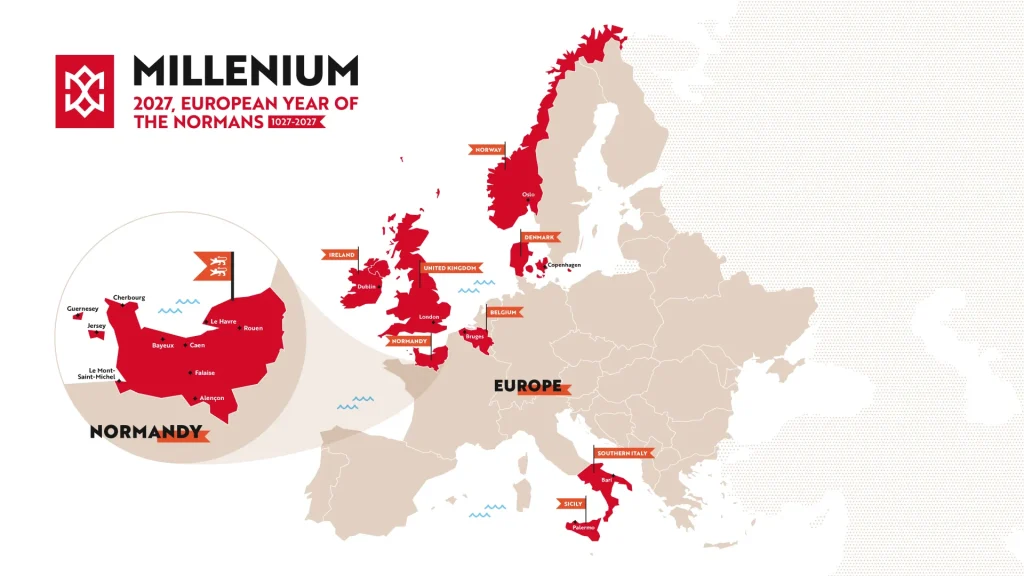
- 7 European regions that share the Normans’ medieval legacy are also taking part in the celebration: the United Kingdom, Ireland, the Channel Islands, Flanders, Southern Italy, Norway and Denmark.
- As the birthplace of this initiative, Normandy invites you to discover this living heritage, where culture meets history, and to meet the people who continue to keep it alive today.
MILLENIUM – 2027, the European Year of the Normans
Nearly 1,000 events across Normandy and Europe are planned as part of MILLENIUM, including the following highly anticipated highlights:
- The Gates of the Millennium, a free and immersive show open to all, held in the cloister gardens of the Abbaye aux Dames in Caen, from 20 to 27 February 2027.
- A major gathering of Viking ships along the estuaries, from 11 to 27 June 2027, culminating in a spectacular arrival (19 to 27 June) at the site of Rouen Armada 2027.
- The exhibition “The Normans in the Middle Ages: A European Adventure (911–1204)” at the Abbaye aux Dames in Caen.
- A major travelling street arts performance presented in several towns and cities across Normandy.
- The exhibition of the missing scene from the Bayeux Tapestry, created by artist Hélène Delprat, at Falaise Castle, the birthplace of William the Conqueror, and at Westminster Abbey.
- A summer programme at the Tower of London, from mid-July to mid-August 2027.
- An extraordinary edition of FÊNO, the Festival of Norman Excellence, from 16 to 19 October 2027.
And also…
Festivals, banquets, and medieval events every weekend, from Falaise to Domfront, via Les Andelys, the Harcourt Estate, and many other emblematic Norman towns of the Middle Ages; a major travelling exhibition of illuminated manuscripts produced in Normandy during the time of William the Conqueror and his descendants; contemporary artistic creations; Gaelic football; historical walks and hikes; and much more.
An Exceptional Partnership with the British Museum
Several cultural treasures will travel between France and the United Kingdom in 2026 and 2027. Among them is the Bayeux Tapestry, which will be displayed at the British Museum in London in an exceptional exhibition from September 2026 to July 2027. It will then return to Normandy and be showcased in a completely redesigned museum.
As part of this partnership, France will host several remarkable works from the British Museum. The Musée des Beaux-Arts de Rouen will present a collection of Italian Renaissance drawings from January to April 2027, followed by several pieces from the famous Lewis Chessmen collection between April and October 2027. Meanwhile, the Musée de Normandie in Caen plans to host the Anglo-Saxon treasure of Sutton Hoo from April to October 2027.
A Thousand Years of History
1027: The Birth of William the Conqueror
Born in Falaise, Normandy, in 1027, William was the son of Robert the Magnificent, Duke of Normandy, and Herleva of Falaise. His future wife was none other than Matilda of Flanders.
Gifted with a strong-willed and determined character, William secured his first major victory in 1047 at the Battle of Val-ès-Dunes, near Caen. At a time when the Duchy of Normandy was weakened by internal unrest, he succeeded in restoring stability and winning the loyalty of his vassals.
Not all of them, however. One of his vassals, Harold Godwinson, would ultimately betray him. Although Edward the Confessor, William’s cousin and the King of England, is said to have promised him the English crown, Harold seized the throne upon Edward’s death.
William refused to accept this challenge. The dispute culminated in the Battle of Hastings in 1066, where William emerged victorious and earned the title by which he is known today: William the Conqueror. Harold, meanwhile, met a tragic fate on the battlefield.
William’s descendants would rule both Normandy and England until 1204, forging close political and cultural ties across the Channel. As a result, French was spoken at the English court for nearly three centuries, leaving a lasting mark on the English language and culture.
Celebrating the Norman Medieval Legacy
It was through the Treaty of Saint-Clair-sur-Epte in 911 that King Charles the Simple granted the Viking leader, Rollo, the territory that would become Normandy. Why such a “gift”? To prevent other Scandinavian raiders from continuing their incursions up the Seine and causing even greater devastation across the kingdom than Rollo and his men had already inflicted in France. Indeed, the very name Normandy literally means “land of the Northmen”. Descendant of Rollo, William would go on to launch his famous conquest of England. In the centuries that followed, Norman influence extended across the British Isles, reaching as far as Ireland. Earlier still, notable Norman leaders such as Robert Guiscard and Roger I had distinguished themselves through their conquests in Southern Italy and the Mediterranean, helping to establish a powerful Norman presence far beyond their homeland.
From the banks of the Seine to the shores of England, Ireland, and the Mediterranean, the Norman legacy shaped the history, culture, and identity of a remarkable part of Europe.
Invaders or Visionary Builders? Even today, opinions remain divided about William the Conqueror and his descendants. One thing is certain: the Normans helped shape Europe in lasting ways, influencing its political, social and legal development while leaving behind an extraordinary architectural and cultural legacy.
Their impact can still be seen across the continent. From the Palace of the Normans in Palermo to the Tower of London, built with stone imported from Caen, and from the cathedrals of Bari and Dublin to the Abbaye aux Hommes and Abbaye aux Dames in Caen, the Normans established themselves as some of the greatest builders of the Middle Ages.
The Normandy Region, which launched the initiative, wanted to bring Europe together around this shared heritage. Mission accomplished. Partners from Italy, the United Kingdom, Flanders, Ireland, the Channel Islands, Scandinavia and France have worked hand in hand to develop events that celebrate the remarkable cultural and historical legacy of William the Conqueror and the generations that followed.
Join a themed tour
Several international tour operators are organising themed group tours for the European Year of the Normans:
Ace Cultural Tours: In the footsteps of William the Conqueror
Racines Voyages: 20 nights in Normandy and southern Italy
Tours International: Year of the Normans tour
Travelbound: William the Conqueror and the Normans school trip
Travel Editions: William the Conqueror and medieval Normandy tour
F.A.Q.
Where will the European Year of the Normans / Millennium of William’s Birth take place?
Throughout Normandy, but also in several European countries marked by the legacy left by William and his successors. In the run-up to the anniversary date, numerous exchange meetings will take place in several countries across the European continent.
Which events will be held as part of the European Year of the Normans/Millennium of William’s Birth?
For several years now, the Millennium Project has been designed to offer you truly spectacular events, worthy of the man himself. Above, you will find the programme highlights for William’s Millennium celebrations.