From Hastings to the palaces of Sicily, the Normans (knights, monks and builders) forged a powerful network that reshaped medieval Europe. A shared historical adventure whose legacy can still be seen today in Normandy and across several neighbouring countries.
William the Conqueror sets the stage for a new chapter
1066 : The Conquest of England
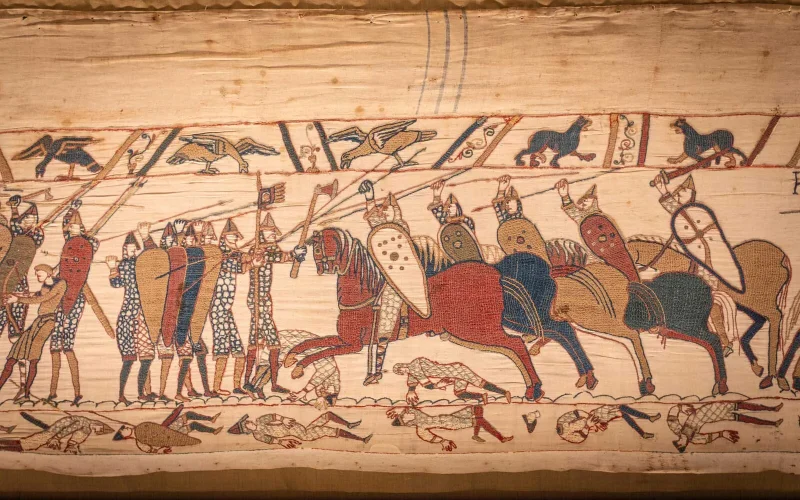
William was born in Falaise around 1027. The illegitimate son of Duke Robert the Magnificent, he inherited the Duchy of Normandy upon his father’s death. However, he first had to assert his authority against Norman barons who challenged his rule. After a series of victories, including the Battle of Val-ès-Dunes, he emerged as the most powerful duke in the kingdom, but his ambitions did not stop there. To claim the English crown, William assembled nearly 15,000 men and more than 1,000 ships, launching what was then the largest naval expedition of its time. On 14 October 1066, he defeated the Saxon king Harold at the Battle of Hastings. Within a few weeks, Dover, Canterbury and Winchester had fallen. London, surrounded and isolated, soon surrendered without a fight. William was crowned King of England on 25 December 1066. His wife, Matilda of Flanders, was crowned queen at Westminster in 1068.
This was far more than a military conquest. French became the language of the royal court and administration, remaining so for nearly three centuries and leaving a lasting imprint on the English language. William also introduced the continental feudal system, reorganised the Church, and ordered a comprehensive survey of the kingdom.
Norman Romanesque Architecture Expands Beyond Normandy
And everywhere, they built. Castles, Cathedrals and Abbeys rose from the ground with an energy that reveals much about the Norman approach to power and faith. The Tower of London and the cathedrals of Durham and Winchester are among the monumental projects completed within just a few decades, and they continue to shape the skylines of English cities today.
Norman Romanesque architectural features (massive naves, square towers and rounded arches) crossed the Channel and became firmly established in England. From Caen to Canterbury, these distinctive forms remain instantly recognisable, reflecting a shared architectural heritage forged through the Norman conquest.

Explore the Legacy of William the Conqueror in Normandy
- Wiliam the Conqueror’s Castle, Falaise: An excellent starting point for exploring the history of medieval Normandy and the epic story of William the Conqueror, brought to life through immersive exhibitions and multimedia experiences.
- Caen Castle: Built by William the Conqueror around 1060, Caen Castle is one of the largest medieval fortresses in Europe. It is also home to the Museum of Normandy, which traces the region’s rich history.
- The Abbaye aux Hommes, Caen: Founded by William himself, this remarkable abbey is the site of his burial. It stands as a masterpiece of Norman Romanesque architecture.
- The Abbaye aux Dames, Caen: Founded by Matilda of Flanders, William’s wife, the abbey complements the great religious ensemble established following the Norman conquest.
- Bayeux Cathedral and the Bayeux Tapestry: Notre-Dame Cathedral in Bayeux was consecrated in 1077 in the presence of William the Conqueror. The town is also home to the museum housing the famous Bayeux Tapestry, an extraordinary medieval masterpiece depicting the Norman Conquest of England in 1066. (The new Bayeux Tapestry Museum is scheduled to reopen in 2027.)
Hauteville Family : Norman Knights in the Conquest of Southern Italy
From Cotentin Peninsula to Sicily
From the early 11th century onwards, Norman knights began making their way to southern Italy. Among them were the sons of Tancred of Hauteville, a minor lord from the Cotentin Peninsula in Normandy. At least eight of them ventured south, settling first in Apulia and Calabria before extending their ambitions to Sicily. William Iron Arm, Robert Guiscard (“the Cunning”), and Roger the Great Count were among the most renowned members of the family. Within a few decades, the Hautevilles established their dominance over territories previously controlled by the Byzantines and Muslim rulers, becoming the driving force behind the creation of the Kingdom of Sicily. The capture of Palermo in January 1072 marked a decisive turning point. In 1130, Roger II was crowned King of Sicily, ruling over one of the most remarkable and sophisticated states of the Middle Ages.
Norman Footprints across Sicily
The Norman legacy remains clearly visible across southern Italy today. In Palermo, the Cathedral, the Palazzo dei Normanni (Palace of the Normans) and the Palatine Chapel are all part of a UNESCO World Heritage Site. In Cefalù, the cathedral founded by Roger II stands proudly by the sea, its twin square towers forming a silhouette that strikingly recalls some of Normandy’s great abbeys.
Roger II brought the Kingdom of Sicily to its height, governing a trilingual realm shaped by a rich blend of cultural influences. Under the reigns of his sons and grandsons, William I and William II, Norman Sicily became an important centre of learning and intellectual exchange. Greek scientific, philosophical and literary works were translated and circulated, while the writings of contemporary Arab scholars were also collected and preserved. Among them was the renowned geographer al-Idrisi, who arrived in Sicily in 1138 and produced some of the medieval world’s most remarkable geographical works.

Learn More About the Hauteville Family
- The Tancrède Museum in Hauteville-la-Guichard tells the story of how a Norman family set out to conquer southern Italy.
- The Pirou Embroidery, a 58-metre hand-embroidered artwork displayed at Pirou Castle, retraces the conquest of southern Italy and Sicily. Inspired by the spirit of the Bayeux Tapestry, it vividly recounts the epic adventures of the Hauteville family.
Henry II Plantagenet and the Powerful Anglo-Norman Empire
But the Norman adventure was far from over. It was now led by Henry II Plantagenet, grandson of William the Conqueror. ount of Anjou and Maine, Duke of Normandy and Aquitaine, and King of England, he ruled over a vast Anglo-Norman empire stretching across both sides of the Channel. Yet Henry continued to seek new territories and greater influence. Rouen, where he regularly held his court, was one of the political and administrative centres of this powerful realm.
The Conquest of Ireland (1170-1175)
It was in this context that Henry II turned his attention to Ireland. A conflict between rival Irish kingdoms created an opportunity when the deposed King of Leinster sought help from Anglo-Norman lords to regain his throne. Among them was Richard de Clare, better known as Strongbow. In 1170, Strongbow captured Dublin using military methods that were largely unfamiliar in Ireland at the time, including motte-and-bailey castles and carefully coordinated attacks by cavalry, infantry and archers.
Concerned that his vassal might establish an independent principality, Henry II crossed to Ireland himself in 1171 and asserted royal authority over the region. The Treaty of Windsor, concluded in 1175, formally recognised Anglo-Norman dominance over much of the island.

The Plantagenet Legacy in Normandy
- The Plantagenets were responsible for the construction and reconstruction of numerous cathedrals across Normandy at the end of the 12th century, including those of Lisieux, Bayeux, Rouen and Sées. These ambitious projects embraced the emerging Gothic style, which rapidly supplanted Romanesque architecture as the dominant form of ecclesiastical construction.
- Richard the Lionheart, son of Henry II Plantagenet, also commissioned the formidable Château Gaillard between 1196 and 1198. Perched high above the Seine Valley, the fortress was designed to control the river and defend Normandy.
Discover the Legacy of Medieval Normandy
From Rouen to Palermo, by way of Dublin and Canterbury, the Normans exported far more than military expertise. They spread new approaches to architecture, government and learning, leaving a lasting mark on medieval Europe. Exploring Normandy today means tracing the origins of this remarkable story and discovering historic sites that still have much to reveal about one of the most influential peoples of the Middle Ages.

MILLENIUM – 2027 : European Years of the Normans
In 2027, Normandy will celebrate MILLENIUM, the European Year of the Normans, with a wide range of events taking place across the region and throughout Europe. The programme includes gatherings of Viking ships, monumental digital projections, exhibitions, contemporary art trails and immersive story-driven quests.
MILLENIUM is an invitation to (re)discover a shared history. A history that began along the banks of the Seine in the 9th century and forged lasting connections between Normandy and England, Ireland, Sicily, Scandinavia and the Channel Islands.
Normandy invites you to explore this living heritage and meet the people who continue to keep its history and traditions alive today.