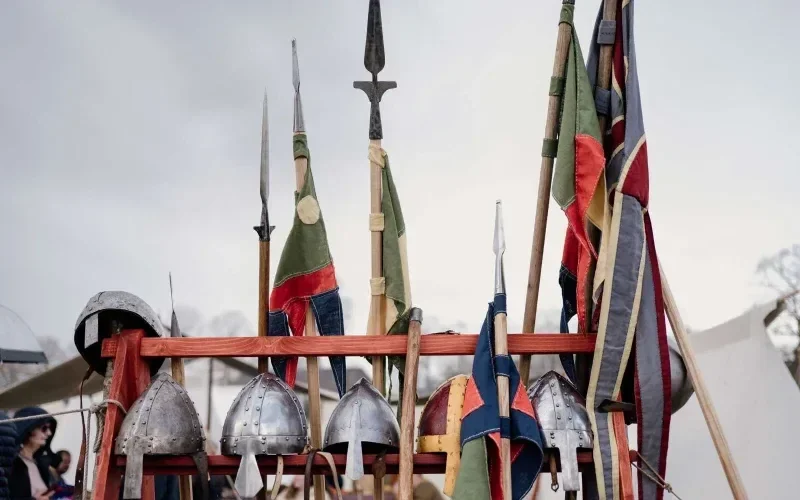
From Vikings and dukes to monks and master builders, the medieval Normans forged the identity and history of their land while reshaping the map of medieval Europe. They also left a legacy of extraordinary heritage, still marked today by the red banner bearing the Norman leopards. Abbeys, fortified castles, historic remains, manuscripts, and tapestries stand as enduring testimonies to this rich millennium of history.

Norman History and Identity
- The Norman draw their identity from over a thousand years of history.
- Although traces of the Gallo-Roman era remain visible throughout the region, Normandy underwent profound transformations during the Middle Ages.
- Successive rulers and powerful dynasties helped shape the duchy’s destiny. From Rollo the Viking to William the Conqueror, and from Falaise to Palermo, Norman influence reached well beyond its borders.
- Norman identity is more than a geographical territory. It is the result of centuries of migration, conquest, and cultural exchange.
- Even today, the British monarch traditionally retains the title of Duke of Normandy in Jersey and Guernsey.
From Vikings to Normans
It all began with the arrival of the Northmen. After carrying out raids across the North Sea and the English Channel, the Vikings, led by a man known as Rollo, reached the river mouth of the Seine in the 880s. Scandinavian raids multiplied across a territory that was not yet called Normandy. Monasteries were burned, and local populations fled. Having become the leader of the Vikings settled along the Seine, Rollo had no intention of stopping there.
In 911, a political decision changed the course of history. The Carolingian king Charles the Simple negotiated with Rollo and granted him a vast territory around Rouen under the Treaty of Saint-Clair-sur-Epte. Rollo converted to Christianity and pledged to defend the region against further incursions. In return, he received land, a title, and legitimacy. In less than a century, the Vikings had embraced Christianity, adopted the local Romance language, and restored many of the abbeys they had previously destroyed. Normandy was born. Its name derives from Northmen, the land of the Men of the North.
The Viking legacy can still be seen in many place names throughout the region. Bolbec, Caudebec, Yvetot, Honfleur, Barfleur and many others owe their distinctive sounds to Old Norse, the language of the Scandinavian explorers. Bec meant a stream, tot an estate or settlement, and fleur an estuary.
Normans Conquests

During the 10th century, under the rule of William Longsword (Rollo’s son) and later Richard I, Normandy expanded westward. It now included the Cotentin Peninsula and the Channel Islands. Several strongholds emerged as major centres of power, notably Rouen and Bayeux, followed by Fécamp, Falaise, and Caen.
A new chapter in this extraordinary story was about to leave its mark on history: that of William the Conqueror. Born in Falaise around 1027, the illegitimate son of Duke Robert the Magnificent and a young Norman peasant woman, he was known from childhood as William the Bastard. Following his father’s death, he inherited the duchy and gradually established his authority over the Norman barons who challenged his rule. In 1066, with an army of nearly 15,000 men and a fleet of more than 1,000 ships, he crossed the Channel and defeated the Saxon king Harold II at the Battle of Hastings. He was subsequently crowned King of England. This conquest, immortalised in the Bayeux Tapestry, would profoundly reshape the course of European history.
Other Norman lords set their sights on the south. The Hauteville family, originally from the Cotentin, gradually conquered Southern Italy (1047–1059) and Sicily (1060–1080), territories where their legacy remains visible to this day.
These Norman kingdoms in England and Sicily helped spread Norman culture and left behind a remarkable architectural legacy: the Tower of London, the cathedrals of Winchester, Norwich, and Canterbury across the Channel, and Cefalù on the Mediterranean. Meanwhile, Caen established itself as a major centre of power, with the largest castle enclosure in Europe (5.5 hectares) and imposing abbeys founded by William the Conqueror and his wife Matilda of Flanders.
A powergul Duchy
In the 12th century, Normandy stood at the heart of a vast political realm. Henry II Plantagenet, his wife Eleanor of Aquitaine, and their sons (including Richard the Lionheart) ruled an empire in constant motion. Their territories extended across western France, as well as England, much of Wales, and Ireland.
he royal court moved constantly throughout the realm, artistic influences spread, and fortresses emerged as powerful symbols of authority. It was also during this period that Normandy embraced the Gothic style. The cathedrals of Rouen, Bayeux, Coutances, and Sées bear witness to outstanding technical mastery and remarkable artistic achievement.
In 1204, King Philip Augustus of France annexed the duchy. Normandy became a province of the French kingdom, yet it did not lose its distinct identity. The region found itself at the centre of the struggle between the Plantagenets, heirs to the Kingdom of England, and the Capetians, heirs to the French throne. Between 1337 and 1453, Norman towns and villages were swept up in the turmoil of the Hundred Years’ War.
Although the duchy formally came to an end in 1469, when the ducal ring was broken in a courthouse in Rouen on royal orders, after 558 years of existence, it left behind an architectural and cultural legacy of exceptional richness. Fortresses, abbeys, Gothic cathedrals, and legendary figures all tell, in their own way, the story of a thousand years that changed the course of Normandy, France, and Europe.


MILLENIUM – 2027, European Year of the Normans
In 2027, Normandy will celebrate MILLENIUM – 2027, European Year of the Normans with an ambitious programme of events taking place throughout the region and across Europe. This unique celebration will shine a spotlight on Normandy, its history, and its outstanding medieval heritage.
The programme will feature a spectacular gathering of Viking ships, a contemporary art route, monumental digital installations, an immersive historical quest, major exhibitions, and much more.
More than a year-long festival, MILLENIUM celebrates a shared European legacy. It tells the story of connections forged in Normandy that continue to link territories across Europe today from England and Ireland to Flanders, Southern Italy, Scandinavia, and the Channel Islands.