You can discover – or rediscover every part of William the Conqueror’s unbelievable CV here in CalVados (sic)! There are traces of his birth in Falaise, his battle in Bayeux and his death in Caen. Castle, Tapestry and Abbey. But there were other characters apart from William the Bastard…
The Château de Caen
Founded before the Norman Conquest by William the Conqueror, Caen Castle is said to be one of the largest in Europe by surface area, and was rebuilt in stone by his son Henry I. It became the favourite residence and palace of the Anglo-Norman King-Dukes, and parts of it survive to this day, including the Salle de l’Exchiquier, a unique 17th-century great hall affording splendid views over William’s city.
Enceinte du Château 14000 CAEN
Your itinerary

The Men’s Abbey (Abbaye aux Hommes)
Also known as the Abbey of Saint-Etienne, this key architectural monument in the Romanesque style was conceived by William’s Lombard builder-priest Lanfranc before the Conquest and inaugurated in 1077. William was buried there in 1087 (a bit of leg remains). One of the earliest ribbed vaults in Europe crowned the nave by 1115. In 1944 its use as an air-raid shelter saved it. The 18th-century convent complex next-door has been used as Caen’s Hôtel de Ville (city hall) since 1963.
Hôtel de Ville Esplanade Jean-Marie Louvel 14027 CAEN
Your itinerary

The Women’s Abbey (Abbaye aux Dames)
Made especially for women the quire of the Abbey of the Holy Trinity was inaugurated in June 1066, as William was planning the Norman Conquest. It would become the final resting place of Matilda, his queen, in 1083 – who lies under a black Tournai marble slab in the quire. The reason for building the Men’s and Women’s Abbeys was said to be in penance for William marrying Matilda, who was a (distant) relative. By building two abbeys (and much else besides), they were let off the hook and granted a dispensation by the Pope. Both abbeys were Benedictine and survived the French Revolution by becoming parish churches.
Région Normandie Place Reine Mathilde 14000 CAEN
Your itinerary
Ardenne Abbey
The Ardenne Abbey was founded in the 17th century and until very recently was surrounded by farmland, some of the richest in France, which the Premonstratensian monks tilled diligently. This is hinted at in the size of the farm buildings within the courtyard, the cider press, the huge tithe barn and the church itself. From its towers Waffen-SS Stardartenführer Kurt Meyer of the 12th SS Panzer kept the Canadians out of Caen for over a month in 1944, and murdered 20 of them in the abbey garden. Today, the church houses the Institut Mémoires de l’Edition Contemporaine.
Abbaye d’Ardenne 14280 SAINT-GERMAIN-LA-BLANCHE-HERBE
Your itinerary

The Bayeux Tapestry
Seventy metres long, the famous Bayeux Tapestry is not a tapestry in fact, but rather a woollen embroidery on a linen backing, almost certainly created in England upon instruction by William’s half-brother Odo, Bishop of Bayeux, who was made Earl of Kent. It was displayed in Bayeux Cathedral on 14 July 1077, and has remained in Bayeux ever since. The orginal purpose of the tapestry was to justify the Norman Conquest before God. After all, hadn’t Harold perjured himself by having crowning himself King? The tapestry tells quite a tale – you could say the Normans were the original spin doctors!
- Important information: End summer 2025, work will also begin on the new Bayeux Tapestry Museum, which will open in 2027, to mark the millennium of the birth of William the Conqueror. To meet this deadline, the current museum will have to be closed to the public after the 2025 summer season. While the museum is being built, the Bayeux Tapestry will be kept in a storage area specifically designed for its conservation.
13 bis rue Nesmond 14400 BAYEUX
Your itinerary
Longues-sur-Mer Abbey
Dedicated to the Virgin Mary, this abbey was founded in the 17th century. Once through the gate, cross the first courtyard bordered by the Abbot’s lodgings, marvel at the ruins of the Gothic church and nearby, a large building that may have once been the refectory. Insiden there are interesting 14th-century frescoes and period ceramic tiles.
17 rue de l’abbaye 14400 LONGUES-SUR-MER
Your itinerary

Château de Colombières
The Château de Colombières is a fortified 14th-century, built in a strategic locationn the edge of the marshes around the bay of Isigny. The tide brings the sea right up to the foot of its walls, acting as a moat. A few days after D-Day, the American army set up its propaganda service here.
Le Château 14710 COLOMBIERES
Your itinerary
Priory of Saint-Gabriel
In the heart of the Bessin countryside, the Priory of Saint-Gabriel-Brécy was founded in the 16th century by the Abbey of Fécamp on the initiative of the Seigneur of nearby Creully Castle. The priory ran the lands, mills and fishponds owned by the abbey in the Bessin area. It is possible to visit the quire in the old Norman abbey church, gatehouse and refectory, which are part of what is now an agricultural school.
1 rue du Prieuré 14480 CREULLY SUR SEULLES
Your itinerary

Château de Crèvecœur
The Château de Crèvecœur is an example of a modest fortified 15th-century farm. It has a moat and is divided into a lower and upper bailey, the former for the farm activities, the latter for the Lord’ who lived there. The 15th-century gatehouse, chapel, dovecote and barn all are fine examples of wattle and daub, brick and stone buildings from this period.
Fondation Musée Schlumberger 14340 MÉZIDON VALLÉE D’AUGE
Your itinerary
William the Conqueror’s castle in Falaise
Falaise Castle is famous for being the site where William the Bastard was born in 1027, and is also a symbol of Anglo-Norman power. The castle we see today was largely the work of William’s youngest son, Henry I. Both a ducal and royal residence, ‘William the Conqueror’s Castle’ has been restored and continues to dominate the town to this day.
Place Guillaume Le Conquérant 14700 FALAISE
Your itinerary
A different way to discover the Middle Ages
Our selection of Normandy Experiences
Normandy Experiences are local gems that add meaning to your trip. You’ll meet Normandy people who are truly passionate about what they do.
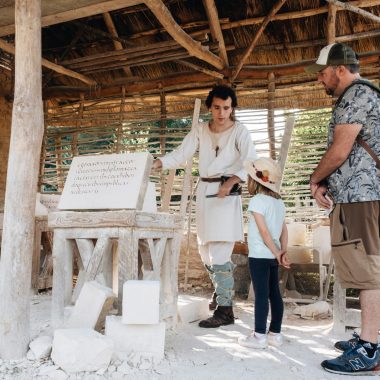
Viking adventures at Parc Ornavik
Hérouville-Saint-Clair