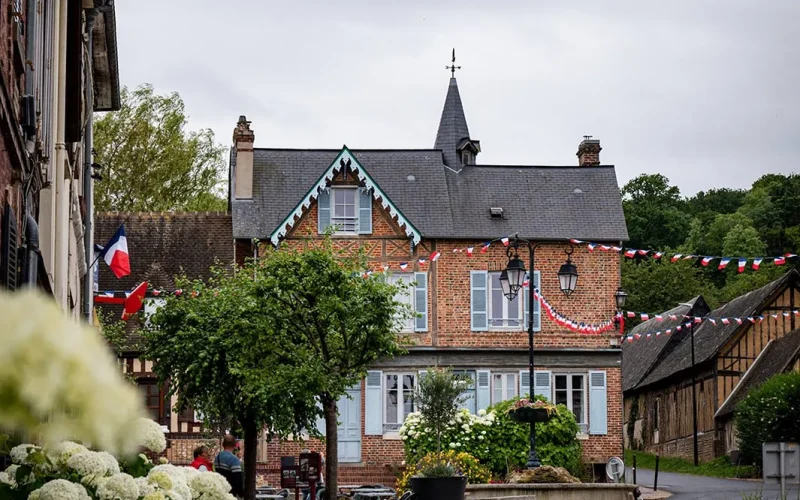
The picturesque village of Blangy-le-Château, tucked away in the heart of the Pays d’Auge, has just been awarded the official ‘Plus Beaux Villages de France’ label. A well-deserved recognition for this beautiful place!
In the heart of the famous Pays d’Auge, Blangy-le-Château has been located in the Chaussey Valley since the Middle Ages. Dominated by seven hills – earning it the nickname of the “Little Rome of Calvados” – the village invites visitors to travel back in time. It has just become the seventh Norman village to receive the official title of ‘Plus Beau Village de France’


Half-timbered houses and historic monuments
In this beautiful village, you’ll find many half-timbered houses with exceptional architectural details, such as the old pharmacy with its carved woodwork, or the 16th century Auberge du Coq Hardi, one of the oldest and most opulent houses in the village. You can still admire the historic sign depicting a rooster… on a fox! Once a coachman’s house, it became an inn during the Revolution and remained so until 1936. Now privately owned, it is a listed building, as are other buildings in the village, such as the manor house built in the mid-17th century, its two pavilions to the north of the garden, and the church of Notre-Dame. The latter, built in the Middle Ages, was completely destroyed during the Hundred Years’ War before being rebuilt in the Gothic style in the 14th century.

Where the water flows…
Water is still omnipresent in Blangy-le-Château, even if the moat of the old castle has disappeared. In addition to the names of the streets that refer to it (chemin des Fontaines, rue du Vieux Lavoir, chemin du Puits…), the village still has its corn mill, whose presence has been documented since 1150 and which is fed by the Chaussey, its wash-house. In the main street, you’ll also find a ditch that connects the two wells of the village. To avoid getting your feet wet, the latter is lined with small wooden footbridges symbolising the old drawbridges of the castle.
History and legends
Nestled between Pont-l’Évêque and Lisieux, Blangy-le-Château owes its name to the local white stone, but also to its ancient castle, to avoid any confusion with other villages in the Blangy. Built around the year 1000 by Gilbert I de Crespin on an earthen mound, the castle consisted of a square wooden keep which was later replaced by a stone keep. Surrounded by a palisade and a moat, the castle was badly damaged during the Hundred Years’ War, burnt down and then completely destroyed in 1410. All that remains today are two sections of the main wall… and a strong belief that a ghost lives at the foot of the old keep. The ghost of a young woman called Claire, dressed all in black, is said to roam the grounds in the evenings… beware!
