Overlooking the Seine Valley from its dramatic clifftop setting, Château Gaillard still stands today as a powerful symbol of Richard the Lionheart’s ambition and authority. A warrior king and brilliant military strategist, Richard left a profound mark on the history of Normandy. Discover the story of a ruler whose heart truly belonged to the Norman duchy.
The Story of Richard the Lionheart
In 1189, Richard the Lionheart, son of Henry II of England and Eleanor of Aquitaine, and great-great-grandson of William the Conqueror, became King of England, Duke of Normandy, Duke of Aquitaine, Count of Poitou, Maine and Anjou. This concentration of power made him the principal rival of the French king, Philip Augustus.
An Unexpected Plantagenet Heir
Although born in Oxford in 1157, Richard was not truly English. His mother, Eleanor of Aquitaine, was Duchess of Aquitaine, while his father, Henry II Plantagenet, was Count of Anjou and Maine, Duke of Normandy, and King of England. Richard was raised in Aquitaine and spoke Latin, Occitan and French, but not English. In fact, during his ten-year reign, he spent only around six months in England.
As the third son of Henry II, Richard was never expected to rule. However, the premature deaths of his two elder brothers, William and Henry the Young King, dramatically changed his destiny. Upon his father’s death, he inherited the titles of King of England, Duke of Normandy and Aquitaine, and Count of Maine and Anjou.
A King More Norman Than English
Under the Plantagenets, Normandy became the centre of a vast political realm. Henry II, followed by Richard, occupied a unique position: as Dukes of Normandy they were vassals of the King of France, yet as Kings of England they were his equals. This uneasy balance led to constant tensions and repeatedly broken peace treaties.
When Richard came to power in 1189, he inherited this fragile situation and chose to strengthen Normandy’s frontier against the Kingdom of France.
“Oc e No”: Richard’s Curious Nickname
Richard’s contemporaries gave him the nickname “Oc e No”, literally meaning “Yes and No.”
Richard was known for his impulsive nature. To some, his sudden shifts in decision-making seemed contradictory. In reality, however, he never lost sight of his objectives. He had little patience for compromise or indecision. For Richard, every question demanded a clear answer: yes or no.
Château Gaillard: Richard’s “Beloved Daughter” and a Symbol of Power
To secure the route to Rouen, Richard commissioned the construction of Château Gaillard, a spectacular fortress perched more than 100 metres above the Seine at Les Andelys. Built between 1196 and 1198 using innovative military engineering for the late 12th century, the project employed nearly 6,000 workers, who laboured day and night for more than two years.

A masterpiece of defensive architecture, Château Gaillard dominated the river and protected the Duchy of Normandy from French invasion. Other fortresses formed part of the duchy’s defensive network, including Gisors, Conches-en-Ouche, Montfort-sur-Risle and Arques-la-Bataille.
Despite his ambitious project, Richard enjoyed his fortress for only a short time. Following his invasion of the French Vexin and a series of victories over Philip Augustus, even the Pope had to intervene to impose a truce between the two rivals.
The King’s Death and the Fall of Normandy
On 6 April 1199, Richard the Lionheart was mortally wounded by a crossbow bolt during the siege of Châlus-Chabrol Castle in present-day Haute-Vienne.
After a seven-month siege, during which the inhabitants were driven to starvation, Château Gaillard finally fell, and Normandy was annexed to the French royal domain. The Normans were forced either to swear allegiance to the King of France or to flee to England. Such was their fate.
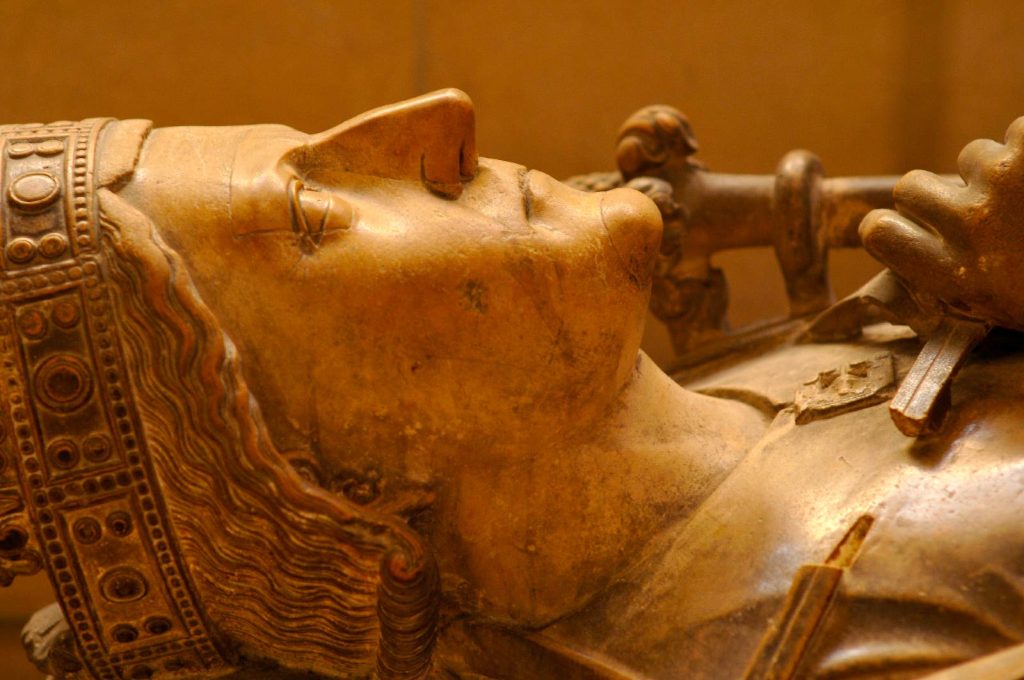
Following medieval custom, his remains were divided after his death. His brain and entrails remained in the Limousin region, while the rest of his body was buried at Fontevraud Abbey beside his parents. His heart was sent to Rouen Cathedral, a gesture said to have been made out of his deep affection for Normandy. Today, it is preserved in the collections of the Museum of Antiquities in Rouen.
King John and the Loss of the Duchy
John Lackland succeeded Richard as ruler. In September 1203, Philip Augustus launched an offensive and blockade against Château Gaillard. After seven months of siege, marked by famine and hardship, the fortress fell. Normandy was then annexed to the French royal domain. The Normans were forced either to swear allegiance to the King of France or to go into exile in England, marking a major turning point in Norman history.
Medieval Sites Connected to Richard the Lionheart
Must-See Sites
- Château Gaillard (Les Andelys)
- Rouen Cathedral: home to the monument marking the former resting place of Richard the Lionheart’s heart.
- Bonport Abbey: founded by Richard the Lionheart in 1189.
- The ruins of Montfort-sur-Risle Castle: part of the second line of defence protecting the Duchy of Normandy.
FAQ
Who Was Richard the Lionheart?
Why Was He Nicknamed “the Lionheart”?
When and Where Was He Born?
Quand est-il devenu roi d’Angleterre ?
How Did King Richard the Lionheart Die?
A different way to discover Normandy history
Our selection of Normandy Experiences
Normandy Experiences are local gems that add meaning to your trip. You’ll meet Normandy people who are truly passionate about what they do.

Viking adventures at Parc Ornavik
Hérouville-Saint-Clair