

Omaha Beach is situated in the American sector, a name code assigned by the Allies during the pivotal D-Day liberation of Normandy. This iconic stretch of coastline extends from Vierville-sur-Mer to Colleville-sur-Mer in Calvados, inviting visitors to explore its profound historical significance and connect with the stories of bravery that shaped the course of history.
The assault on Omaha Beach
If there is one place where the D-Day landings nearly met with disaster, it is undoubtedly Omaha Beach. The chosen location was far from ideal for an amphibious assault, presenting significant risks; however, it was the only feasible option between the British sector of Gold to the east and Utah Beach, the second American landing site, to the west along the Cotentin coastline. From Grandcamp to Arromanches, the shoreline of the Bessin is marked by steep limestone cliffs that rise several dozen metres above the sea. In contrast, before the villages of Vierville, Saint-Laurent, and Colleville lies a 6 to 7-kilometre indentation, where the coast gently slopes to form a steep embankment leading to the beach, accessible through narrow, sheltered valleys.

The site, due to its rugged topography, was highly defensible. A total of fourteen Widerstandsnester, or “resistance nests,” were established, primarily located at the entrances of the narrow valleys that lead from the beach up to the plateau. These approaches were further fortified by anti-tank walls, creating formidable obstacles for any advancing forces. Throughout the area, the Germans had strategically positioned artillery, machine gun nests, mortars, minefields, and extensive barbed wire, all designed to repel an amphibious assault and inflict maximum casualties on the Allied troops.
In March 1944, the beach was assigned the codename Omaha, named after a city in Nebraska. Just three months later, it would become infamously known as “Bloody Omaha,” a moniker that reflected the devastating casualties incurred by the V Corps of the United States Army during the D-Day landings. This corps comprised the 1st Infantry Division, commanded by General Huebner, and the 29th Division, led by General Gerhardt. The term “Bloody Omaha” serves as a stark reminder of the fierce combat and significant losses that characterized the American assault on this crucial stretch of coastline.
What to visit in the American sector of Omaha Beach?
01
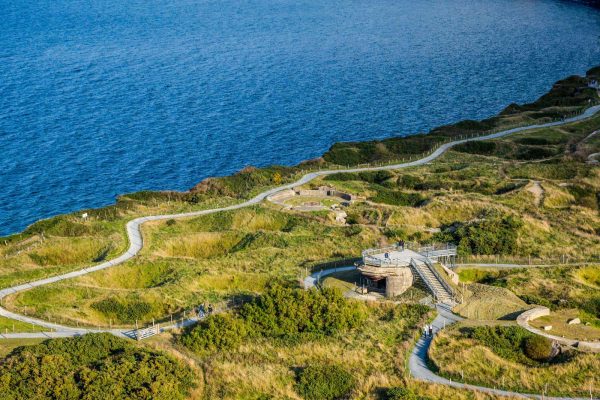
The Pointe du Hoc
Pointe du Hoc is a significant landmark of the D-Day landings. This strategic point of the Atlantic Wall was stormed on the morning of June 6 by the men of Colonel Rudder.
The site still bears the marks of numerous shell craters, which remain clearly visible.
02
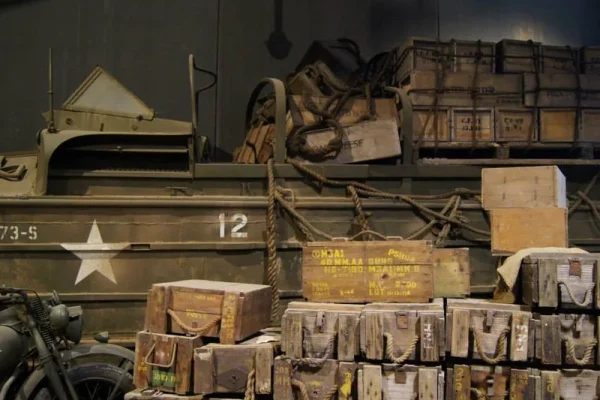
Overlord Museum Omaha Beach
This museum houses over 10,000 artefacts that vividly illustrate the history of the Battle of Normandy up to the liberation of Paris through life-sized reconstructions.
03
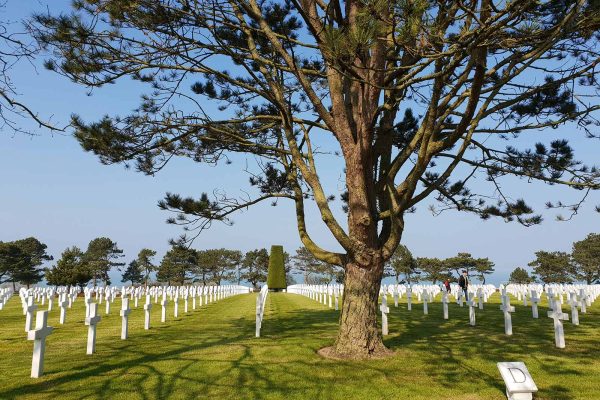
Normandy American Cemetery and Visitor Center
Overlooking Omaha Beach in Colleville-sur-Mer, this impressive memorial site gathers the graves of 9,387 soldiers who fell during the D-Day landings and the Battle of Normandy.
04
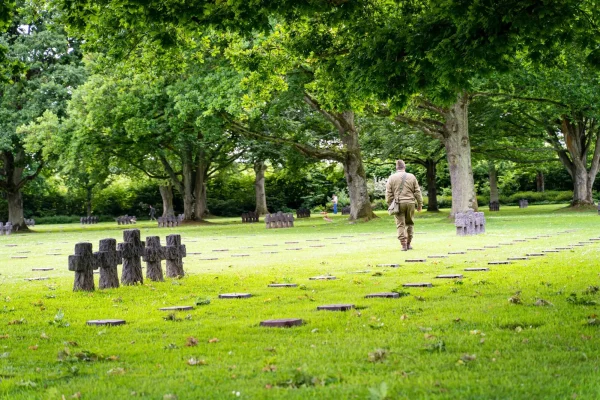
German Military Cemetery of La Cambe
This cemetery is the final resting place for over 21,200 German soldiers who fell during the fighting from June to August 1944 in the Battle of Normandy.
05
Omaha Secret D-Day Museum
Thousands of original artefacts are on display in the heart of Omaha Beach, in an authentic period American building. Situated between the American cemetery and Pointe du Hoc, the museum presents, through an enriched and reimagined exhibition design, a unique collection of treasures – including the Enigma machine, the FG42, Resistance equipment and more –…
More information
06
Overlord Museum – Omaha Beach
Located at the roundabout leading to the Normandy American Cemetery near Omaha Beach, the Overlord Museum boasts a unique collection of over 10,000 exhibits, including 35 vehicles, tanks and guns. Come and discover its life-size display, retracing the major phases of the Normandy Landings.
More information
07
Omaha Beach Memorial Museum
With an exhibition area of 1,400m², located just 200 m from Omaha Beach, the Memorial Museum will help you dive into the heart of the landing story. Since more than 25 years, in Saint-Laurent-sur-Mer, the museum pays tribute to the soldiers who landed on our beaches. With their many dioramas, pictures and thematic display panels,…
More information
08
Château de Colombières
Listed historic monument, located between Bayeux and Isigny sur Mer, in the vicinity of the D-Day landing beaches, the Château de Colombières was one of Lower Normandy’s finest military fortresses during the feudal period. From William the Conqueror to WWII, the defensive purpose of this fine edifice bears witness to over a thousand years of…
More information
09
Le Bunker WN 89 de Géfosse
Not to be missed! At 10am every Sunday, a colourful character by the name of Luc Le Gleuher offers you a guided tour of ‘WN 89’, a former German bunker located in Géfosse-Fontenay. You can also discover the whole story of this element that was part of the Atlantic Wall, today totally intact. Free tour…
More information
10
Maisy Battery
Buried for 60 years, this German battery was an integral part of a military zone, used for opening fire on Allied troops across the beaches of Utah and Omaha. The final assault of the 5th and 2nd Battalion of American Rangers on 9 June 1944 lasted 5 long hours. Visitors can explore 3 km of…
More information
11
Maison de la Libération
In the heart of the D-Day beaches THE HOUSE OF LIBERATION June 6, 1944 was the first house liberated on the morning of June 6 by the ALLIES AMERICAN sector in OMAHA BEACH SAINT LAURENT SUR MER . It is a HISTORICAL place and a WITNESS OF D-Day, the house is reconstructed as in this…
More information

A Normandy Experience to enjoy
Join an exciting guided electric fat bike tour along the stunning shores of Omaha Beach!
Useful information for your trip

Save up on attractions with the Explore Normandy Pass!
Visit more and spend less with the Explore Normandy Pass! Gain free access to exclusive content and, for just €1, enjoy exceptional discounts at over 70 sites and museums dedicated to D-Day in Normandy.
Frequently Asked Questions
Why the name Omaha Beach?
The beaches of Utah and Omaha were designated as code names, named after the hometowns of two American non-commissioned officers involved in the D-Day operations.
Who landed on Omaha Beach?
On the morning of June 6, 1944, 34,250 men of the American Army landed at Omaha Beach. This beach, a pivotal site of the Normandy landings, suffered the highest number of casualties on D-Day, with 4,100 soldiers killed, wounded, or missing.
What is the nearest major city to Omaha Beach?
The nearest major city in Normandy to Omaha Beach is Bayeux, which is easily accessible by train.Alternatively, if you’re travelling from the UK, you can take a ferry from Portsmouth to Ouistreham, providing a route directly into Normandy, close to Caen and Bayeux.