Richard the Lionheart is a historical and legendary figure, famous for his reign as King of England and his exploits in the Holy Land at the end of the 12th century. He also left his mark on the history of the Duchy of Normandy. His life is marked by surprising and remarkable events.
Richard the Lionheart should not have ruled Normandy and England
Richard was the third son of Henry II Plantagenet. He was therefore not destined to succeed his father. However, his two older brothers, William and Henry the Younger, died young. As a result, Richard was crowned King of England, Duke of Aquitaine, Duke of Normandy and Earl of Maine and Anjou on the death of his father Henry II.
King of England, Richard the Lionheart… didn’t speak English!
Although he was born in Oxford in 1157, his origins lie well beyond the English Channel! His mother, Eleanor of Aquitaine, was Duchess of Aquitaine and his father, Henry II Plantagenet, was Duke of Anjou, Maine, Duke of Normandy and King of England. He was brought up in the Aquitaine region and spoke Latin, the Langue d’Oc and French. However, he did not speak the language of some of his people, English! In the 10 years of his reign, he actually only spent six months in England.

His contemporaries nicknamed him ‘Oc e No’, meaning ‘yes and no’ in Langue d’oïl
Richard is very impulsive. This leads him to make the opposite decisions from one day to the next, although he never loses sight of his goals and has no tolerance for half-measures or diplomatic responses. When it comes to answering the slightest question, there’s only one answer: yes or no!
Château-Gaillard in Les Andelys, the ‘beloved daughter’ of Richard the Lionheart
Château-Gaillard overlooked the River Seine to protect the Duchy of Normandy from any French invasion by King Philippe Auguste. Its construction between 1196 and 1198, based on a unique military design from the late 12th century, was made possible by an enormous financial and human investment (6,000 workers worked day and night for more than 2 years). Richard enjoyed his castle for only a short time. He died in 1199, wounded by a crossbow bolt during the siege of Châlus (Limousin).
Richard the Lionheart’s slaughtered royal remains
When he died, according to tradition, his body was butchered. His brain and intestines remained in Limousin, where he died. The rest of his body was buried in the abbey of Fontevraud (Maine-et-Loire), near his parents. His heart was sent to Rouen Cathedral out of “love for Normandy”. Richard’s heart is no longer under the bier. It is now kept in the reserves of the Rouen Museum of Antiquities.
A different way to discover Normandy history
Our selection of Normandy Experiences
Normandy Experiences are local gems that add meaning to your trip. You’ll meet Normandy people who are truly passionate about what they do.
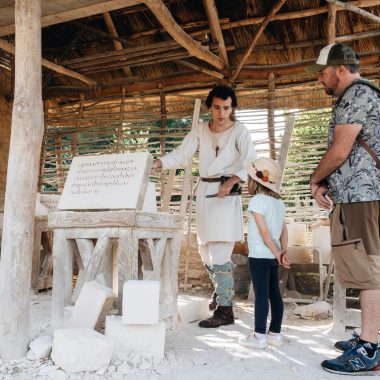
Viking adventures at Parc Ornavik
Hérouville-Saint-Clair

Jeep Ride through History: Tracing the 101st Airborne
Sainte-Marie-du-Mont
Thematics