

Holidays to Normandy offer unparalleled opportunities for discovery, providing kids with a hands-on history lesson that beats any book. On this family visit to the Juno sector of Normandy’s D-Day landing beaches, we opt for the immersive “Explore Juno” tour at the Juno Beach Centre. Led by a young guide from Quebec- about the same age as the soldiers sent to the front- we uncover the remarkable story of Canadian involvement in the liberation of France, uniting history with the present in a moving and inspiring exploration for the whole family.
Camille, tour guide at the Juno Beach Centre & Canadian student
Meet Camille, a Canadian tour guide from Gatineau, near Ottawa, Ontario. Passionate about history, she’s diving into her master’s studies while sharing her infectious enthusiasm on every tour she leads at the Juno Beach Centre.
Activity Overview
Greg and Olivia share their story
At the museum entrance, photos of the Canadian guides available are on display. Our guide for the day, Camille, approaches, and her delightful Canadian accent immediately captivates us.
An Immersive Video Experience to Begin
The first room plunges us in the solemn atmosphere of the Allied Landing. Seated within a replica of a landing craft, we watch a 4-minute video projected at 180 degrees on the walls, vividly capturing the Canadian mindset during World War II. The children are absorbed in the film, keeping silence throughout. One phrase particularly resonates: “such a beautiful country devastated.” The second room delves into Canada of the 1930s, providing valuable context. Our guide positions herself on a sprawling map of Canada on the floor, a territory 16 times the size of France, yet notably less populated!
Touchscreen Tablets and Poppies
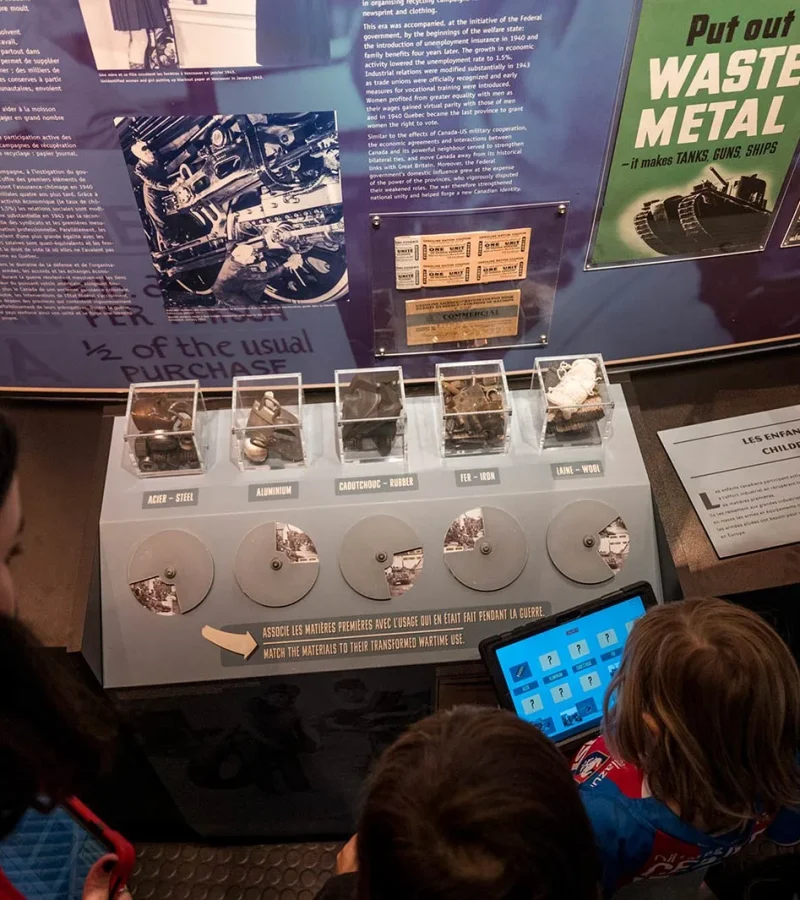
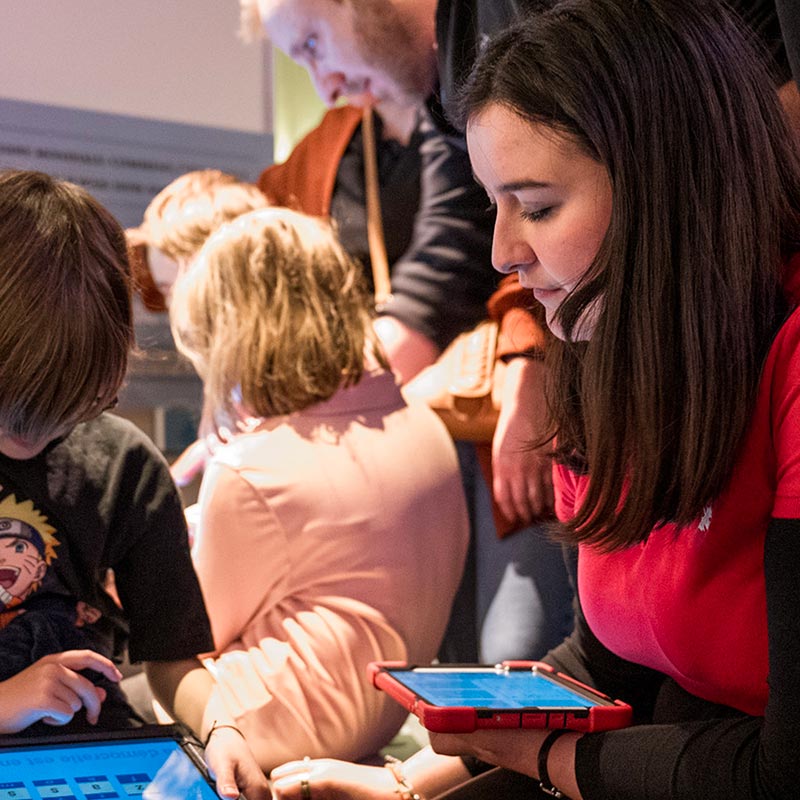
Camille then outlines our mission with enthusiasm. Providing each team with a touchscreen tablet, she explains that interactive modules are key components of our experience. As we progress through the tour, our goal is to collect poppies by answering questions on the tablet. Why poppies? They symbolize peace, as they were the first flowers to bloom on the battlefields after World War I.

Passing On the Values of Peace
We hop from one module to the other, teaming up to tackle the quizz together. Whenever one of the families hits a snag with a question, Camille is there to offer guidance. And when our daughter, with a little help from her dad, nails a correct answer, she bursts with excitement, it’s a joy to behold! Interestingly, many questions are aligned with the museum’s strong advocacy for sustainability.

Paying Tribute to the Heroes
In the second-to-last room, tribute is paid to the 45,000 Canadian soldiers who sacrificed their lives for France during World War II. Overhead, their names, often accompanied by their age at the time of their passing, scroll by. With the guide, we get a chance to discuss the failure of the Dieppe Raid in August 1942, during which Canadian forces suffered significant losses. The guide then mentions the “funnies” (quirky tanks, quite literally). These amphibious tanks were designed following the unsuccessful Dieppe landing attempt, which provided crucial insights.
Meaningful Discussions with our guide
In the final room, a stark contrast awaits. The high ceiling and abundant light create a striking atmosphere, with poppies dominating the scene. Through vast windows, the sea is visible. Children settle comfortably on plush floor cushions as Camille stands before a large touchscreen. The debrief begins! The guide encourages the kids to participate in discussions. “What does remembrance mean?” she asks. “Does anyone know what a veteran is?” . The children eagerly chime in. Then, she asks each of them what they enjoyed the most. Each child’s experience is deeply personal: for our youngest son, it was the joy of crossword puzzles; our daughter found resonance in the portrayal of women’s wartime contributions; and for our eldest, the scrolling names of Canadian soldiers left an indelible mark, each reflecting the exhibition’s profound impact in their own way.

Taking Memories Home
As our tour draws to a close, Camille gifts us each a poppy (the flower of remembrance) and a Canadian flag pin. This experience proves deeply enriching for both us and our children. With heartfelt thanks to our guide, we venture outside. Pausing by the memorial stones at the museum’s entrance, we make our way to the vast expanse of sandy beach where these liberators once landed. Here, in the open air, we take time to reflect as a family. Paying tribute to their memory and walking side by side, with a new appreciation for the ground they once trod and for the freedom we enjoy today.

Useful Information
Voie des Français Libres 14470 COURSEULLES-SUR-MER
Your itinerary
Dates and Rates
All information is accurate at the time of publication but may be subject to change. Please verify before planning your visit.
Family Tour “Explore Juno: Following in the Footsteps of Canadians”
Book by calling + 33 (0)2 31 37 32 17 or via email at [email protected]
Duration: 1 hour 30 minutes
From 6 years old.
Children must be accompanied by an adult.
From 2 to 5 families, up to 30 people maximum. Subject to cancellation if fewer than 2 families are registered.
Dates 2026
- Sunday 21 February at 2pm
- Sunday 11 April at 2pm
- Sunday 11 July at 2pm
- Sunday 23 August at 2pm
- Sunday 3 October at 2pm
Rates 2026
Adult rate: 9€ / 8-18 years old rate : 7€ (see museum website) + 2.50€ per person for the Explore Juno guided tour.
Family rates available.
Free for children under 8, as well as individuals with disabilities, with a reduced rate for their companions.
The Juno Beach Centre proudly supports the Normandy Low Carbon Rate initiative, offering discounts to visitors who choose eco-friendly transportation to the museum!
How to get there by Public Transport?
The small coastal town of Courseulles-sur-Mer is accessible via Nomad car, departing from Caen or Bayeux, two cities with excellent train connections.
Travel from the UK to Normandy with direct ferry routes
If arriving on the Eurostar from the UK via Paris Gare du Nord, transfer to Gare Saint-Lazare for trains heading to Normandy.
From Paris Roissy Charles de Gaulle Airport, take the RER Line B to Châtelet-les-Halles. At Châtelet-les-Halles, transfer to Metro Line 14 direction Saint-Denis-Pleyel and stop at Gare Saint-Lazare, where trains to Normandy depart.
Travelling to the Juno Beach Centre by bike or public transport? Keep your receipt and enjoy entry discounted rates as part of the Normandy Low Carbon Rate scheme!
For more information, please visit the Tourism Office website.
Accessibility for All
The Juno Beach Centre has the ‘Tourisme & Handicap’ label and ensures accessibility for all visitors, offering a single-level layout suitable for individuals with motor disabilities or reduced mobility.
Additionally, the museum provides facilities for visitors with visual or hearing impairments, as well as those with cognitive impairments, in line with inclusive principles.
Check out the museum’s website for further information on accessibility.
Where to Stay?
Résidence Pierre et Vacances Le chant des oiseaux, in Courseulles.
Camping Donjon De Lars****, in Courseulles.
Where to Eat?
Afternoon tea after the visit? Here’s two of our favorite spots:
Coffee and tea, 12 quai ouest in Courseulles-sur-Mer
Les p’tits curieux, tea salon, gourmet snacks and wine bar
Right next to the museum, La Maison bleue has a great lunch and dinner menu. Specialties include seafood and fish.
Would you like to live the same experience?
Accompanied by a Canadian guide, families join the Juno Beach Centre's interactive youth tour of the museum, engaging in educational tablet games and meaningful discussions together.
Courseulles-sur-Mer
From 9 €
Once a month
What made it special
A fascinating and moving museum dedicated to the civilian and military efforts of Canadians during World War II.

Courseulles-sur-Mer
Sea Kayaking amid iconic D-Day landmarks
Arromanches-les-Bains
D-Day & the Battle of Normandy: 10 offbeat sites to explore
June 6, 1944 marks the historic landing of the Allies in Normandy, but the echoes of war continue to reverberate far beyond our shores. For three relentless months, the flames of battle continue to engulf our lands. Immerse yourself in the untold stories of Normandy, wander beyond conventional D-Day trails and embark on an extraordinary...
Explore the Past in Motion: History & Sports on D-Day Beaches
From Cotentin’s eastern coast to the Côte de Nacre, through the beaches of the Bessin, the Normandy coastline resonates with the poignant echoes of the D-Day landings. The memory of the summer of 1944 endures on the edges of Utah, Omaha, Gold, Juno, and Sword beaches, as well as inland. Today, in all seasons, visitors...