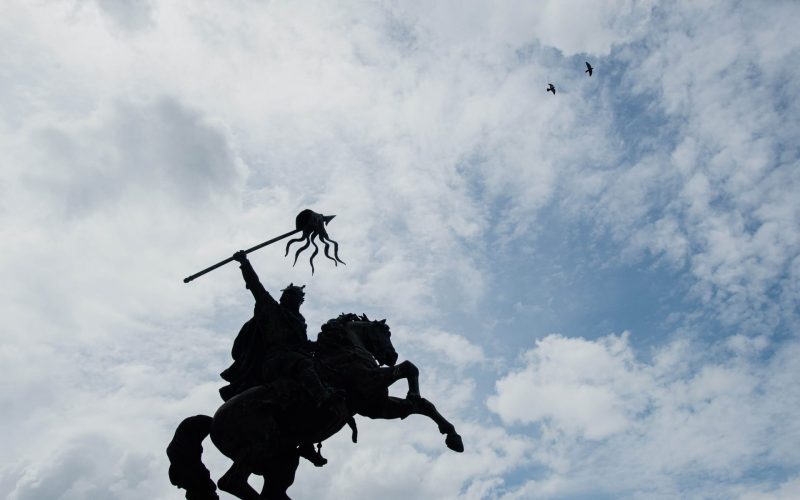
Of all the Dukes of Normandy, William the Conqueror is undoubtedly the most famous and fascinating. The great-great-great-grandson of the Viking leader Rollo, William first became Duke of Normandy before extending Norman power across the Channel and conquering the Kingdom of England.
The Story of William the Conqueror
The Bastard Who Became Duke of Normandy
William the Bastard was born in Falaise from an unmarried union between Robert I the Magnificent and Herleva (Arlette), a young Norman woman of humble origins. According to tradition, Robert first saw her washing clothes at the foot of the castle after a hunting trip and fell in love with her. She became his companion and soon gave birth to his heir.
In 1035, upon the death of his father and while still a child, William inherited the title of Duke of Normandy, a succession that aroused the jealousy of several Norman barons. In 1046, after coming of age, William became the target of an assassination plot organised by those same nobles, who refused to accept his authority. Forced to flee Valognes by night, he crossed the marshlands of the Baie des Veys before finding refuge in Falaise. His victory at the Battle of Val-ès-Dunes in 1047 finally enabled him to establish his authority over the Norman nobility.
In his personal life, William married Matilda of Flanders. In Caen, while William commissioned the construction of a castle and an abbey, the Abbaye aux Hommes (Men’s Abbey), Matilda founded the Abbaye aux Dames (Women’s Abbey). Both monuments have survived the centuries and remain among Normandy’s finest historical treasures.
The Battle of Hastings and the English Throne

William made Caen his political capital. The year 1066 proved decisive. Following the death of King Edward of England, Harold broke the oath he had sworn and had himself crowned king, despite William’s claim to the throne. William therefore launched an invasion from Normandy to seize the crown. The famous Bayeux Tapestry vividly recounts the story of this conquest.
To carry out such an ambitious campaign, William assembled a vast coalition and built a fleet and army. Acting alone, he could never have undertaken such an expedition. In fact, he owned only one ship himself, a vessel gifted by his wife and known as La Mora. Nearly a thousand additional ships were specially built for this extraordinary crossing.
The campaign culminated in one of the most significant battles in European history. On 14 October 1066, William won the Battle of Hastings, and on 25 December 1066, he was crowned King of England at Westminster.
After becoming king, William focused on establishing a strong and efficient administration. He replaced many Saxon abbots and bishops with Norman churchmen loyal to his rule. These Norman clerics also helped spread Norman architectural styles throughout England, overseeing the construction of major landmarks such as the Tower of London and the cathedrals of Norwich, Durham and Winchester.
At the same time, other Norman lords were extending Norman influence into southern Italy and Sicily.
The powerful military and administrative system established by William the Conqueror would be successfully developed and expanded by his heirs and descendants.
Medieval Sites Linked to William the Conqueror
Must-See Sites
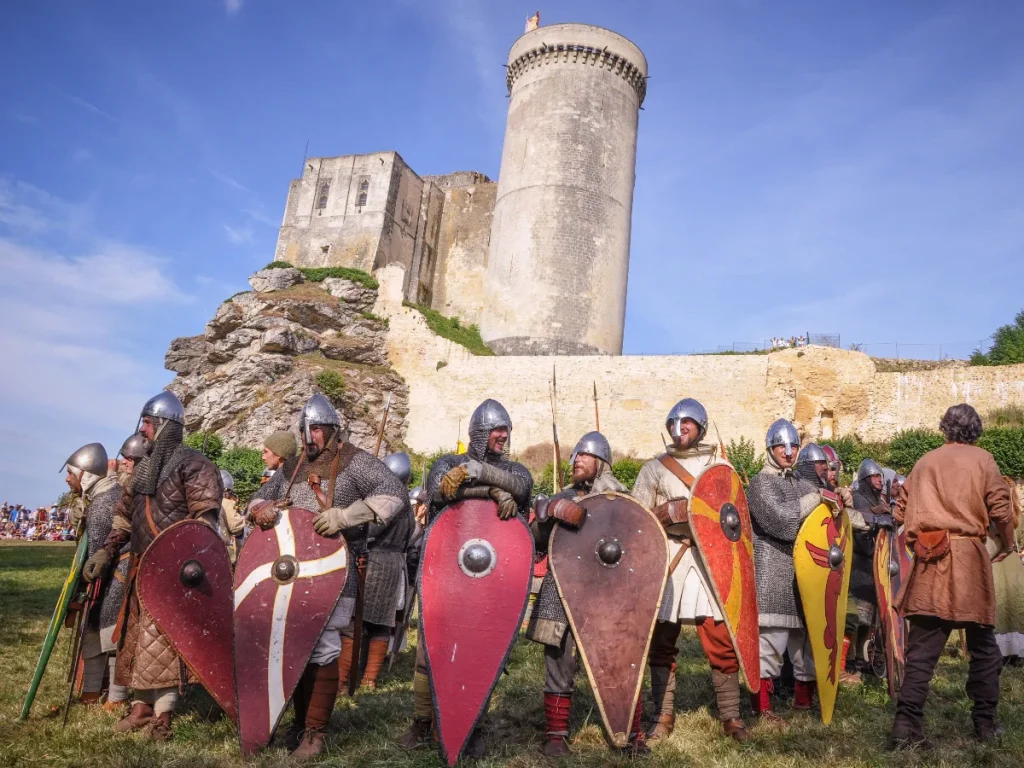
- William the Conqueror’s Castle, Falaise: An excellent introduction to medieval Normandy and William’s extraordinary life, with immersive exhibitions bringing his history to life.
- Caen Castle: Built by William around 1060, it is one of the largest medieval fortresses in Europe and is also home to the Museum of Normandy.
- The Abbaye aux Hommes, Caen: Founded by William himself and the place where he is buried. It is a masterpiece of Romanesque architecture.
- The Abbaye aux Dames, Caen: Founded by Matilda of Flanders, William’s wife, it forms part of the remarkable religious complex established after the conquest.
- Bayeux Cathedral and the Bayeux Tapestry: Notre-Dame Cathedral in Bayeux was consecrated in 1077 in William’s presence. The town is also home to the museum displaying the famous Bayeux Tapestry, the remarkable medieval masterpiece that recounts the conquest of England in 1066. (Please note: the new museum is scheduled to reopen in 2027.)
Other Sites Worth Visiting
- The ruins of Domfront Castle, offering panoramic views over the town.
- The William the Conqueror Art Village in Dives-sur-Mer.
At What Age Did William Become Duke of Normandy?
William became Duke of Normandy in 1035, following the death of his father, when he was just eight years old.
When Did William the Conqueror Die?
Si la vie de Guillaume a été marquée par des victoires héroïques, il va mourir dans des circonstances tragiques. A l’été 1087, alors qu’il livre bataille contre les troupes du roi de France à Mantes-la-Jolie, il est gravement blessé par son propre cheval. Transporté à Rouen, il y agonise pendant plusieurs semaines, prenant toutefois la précaution de régler sa succession. A sa mort, il est inhumé selon sa volonté dans l’église abbatiale Saint-Etienne de Caen.
Where Is William the Conqueror Buried?
His tomb can still be seen today in the Abbey Church of Saint-Étienne in Caen (the Abbaye aux Hommes), although it is sadly somewhat empty. Looted in 1562 during the French Wars of Religion, it now contains only William the Conqueror’s left femur, the rest of his remains having been taken by Protestant troops.
A different way to discover Normandy history
Our selection of Normandy Experiences
Normandy Experiences are local gems that add meaning to your trip. You’ll meet Normandy people who are truly passionate about what they do.
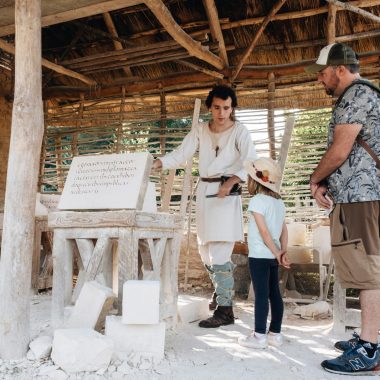
Viking adventures at Parc Ornavik
Hérouville-Saint-Clair