Three towns in Normandy, a common thread, a figure who changed the course of European history. In Falaise, Caen and Bayeux, William’s legacy is still evident. Before setting out to explore these three towns, you can (re)discover who William the Conqueror was. Then follow the route, from the Duke’s birthplace to the Tapestry depicting the conquest of England.
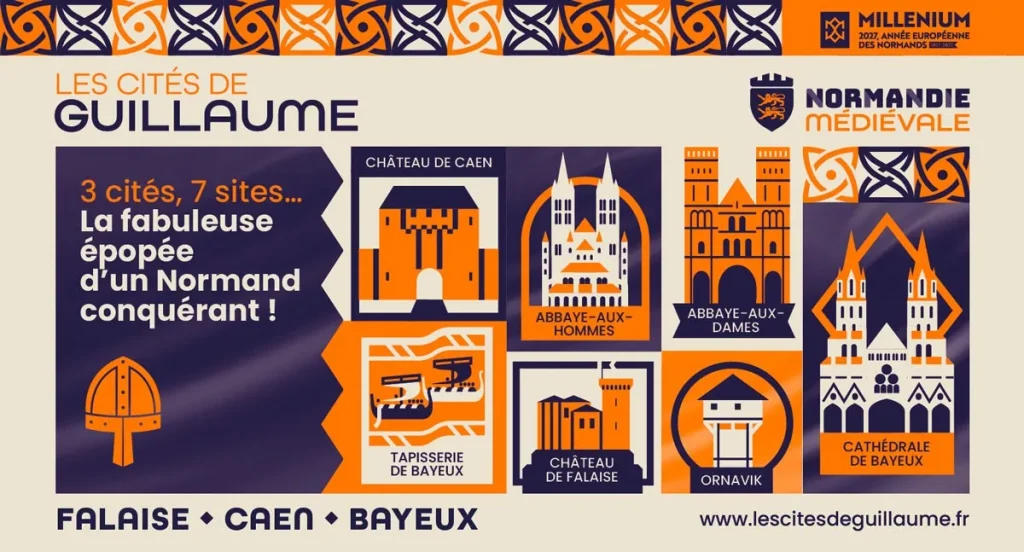
Discover the sites associated with William the Conqueror
Three towns, one thread. Discover all the places to visit in Falaise, Caen and Bayeux that shed light on the century of William: abbeys, castles, museums and medieval ruins.
To relive this era in the three towns throughout the year, with medieval festivals, re-enactments, talks and temporary exhibitions, please visit the ‘Cités de Guillaume’ events calendar page.
As well as the major sites already mentioned, there are other places in the three towns that allow you to continue your journey back to the Middle Ages. Discover below the places to visit in Falaise, Caen and Bayeux as you follow in William’s footsteps. To time your visit to coincide with a highlight, you can also find the list of medieval events in Falaise, Caen and Bayeux.
Falaise, or the Birth of a Legend
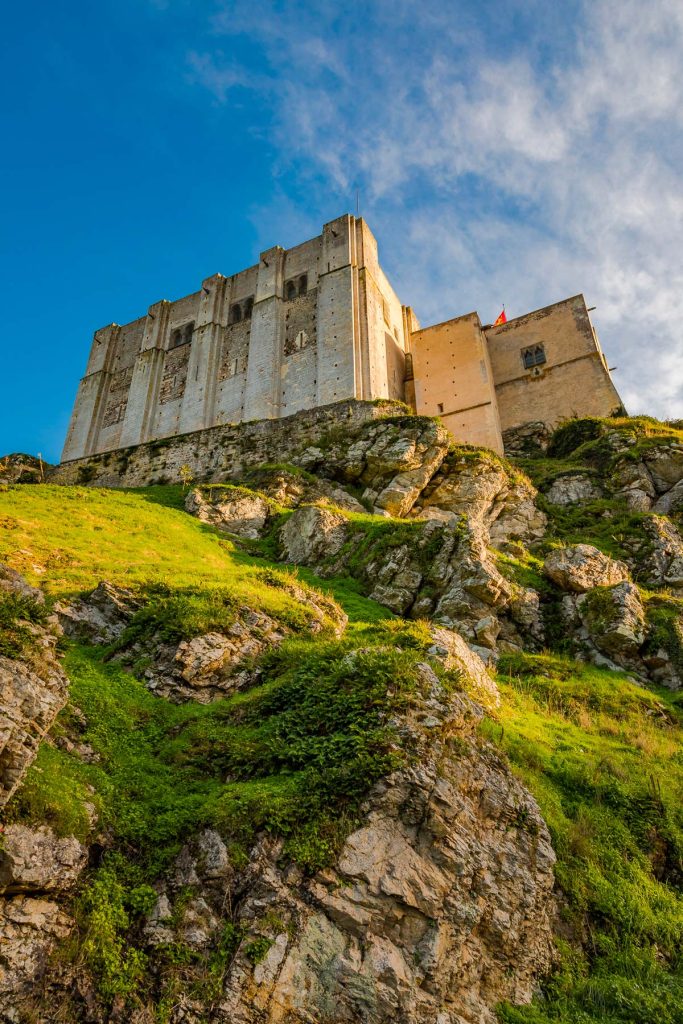
It was in Falaise, around 1027, that the child who was to become William the Conqueror was born, the son of Robert the Magnificent, Duke of Normandy, and Arlette, the daughter of a local tanner. Legend has it that it was during a stay in the town that Duke Robert first caught sight of Arlette, bleaching her linen at the Val d’Ante fountain, and fell madly in love with her. And that after their first night together, Arlette is said to have dreamt of a great tree sprouting from her body, spreading its branches across the whole of Normandy. A prophetic dream thus heralding the birth of the illustrious conqueror a few months later.
Perched on its rocky outcrop, between the Ante and Marescot valleys, Falaise Castle has watched over the medieval town where Guillaume grew up for nearly a thousand years. Altered several times by the Dukes of Normandy – who were also Kings of England and used it as their residence – and later by the King of France, the now-restored castle complex houses an exceptional ensemble of three keep towers, which stand as a unique architectural testament to the history of Normandy. Inside, an immersive exhibition transports you to the heart of the daily life of medieval dukes and kings, recreating the lost interiors against the bare stonework. For children, it offers a tangible gateway to the 11th century.
Caen, capital of a duke who became king
After Falaise, where William was born and spent his childhood, it was in Caen that the future King of England chose to establish the centre of his power. In the mid-11th century, he made this rapidly growing city his principal residence and set about transforming it into the true capital of the Duchy of Normandy. He had a fortress and two great abbeys built there, making Caen one of the major political and religious centres of medieval Normandy.
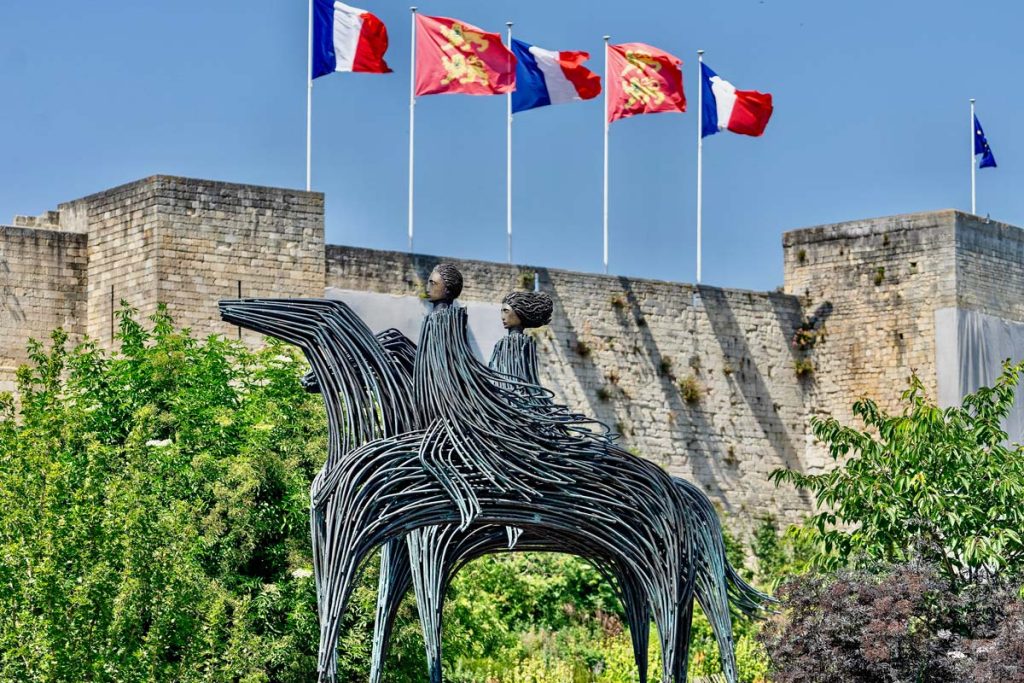
Three iconic monuments still bear witness to this ambition today. Caen Castle, built around 1060, became one of the largest fortified complexes in Europe and serves as a reminder of the Duke of Normandy’s power. The Abbaye-aux-Hommes, founded by William, houses the tomb of the Conqueror in the Abbey Church of Saint-Étienne; he chose Caen as his final resting place. Finally, the Abbaye-aux-Dames, founded by his wife Matilda of Flanders, houses her tomb in its choir.
The two buildings were designed as mirror images of one another, in fulfilment of a penance imposed by the Pope: their marriage, deemed to involve too close a family relationship, was to be atoned for by the establishment of a charitable foundation on either side of the town. Together, they form an exceptional example of Norman Romanesque architecture.
In Caen, therefore, Guillaume did not merely leave behind monuments: he shaped a city worthy of his destiny. Children can thus step back in time and follow in his footsteps as they discover the three iconic sites of this ducal city.
Bayeux, guardian of the Tapestry
Bayeux, also in Calvados, is not a town where William lived: it is the town where his story was told. And not just any old way: on a strip of embroidered linen nearly 70 metres long, unfolding like a film, frame by frame. The Bayeux Tapestry (which is technically not a tapestry but an embroidery) has been inscribed on UNESCO’s ‘Memory of the World’ Register since 2007. This distinction should be clearly distinguished from World Heritage status: here we are referring to the documentary memory of humanity, that is to say, archives and manuscripts deemed essential.
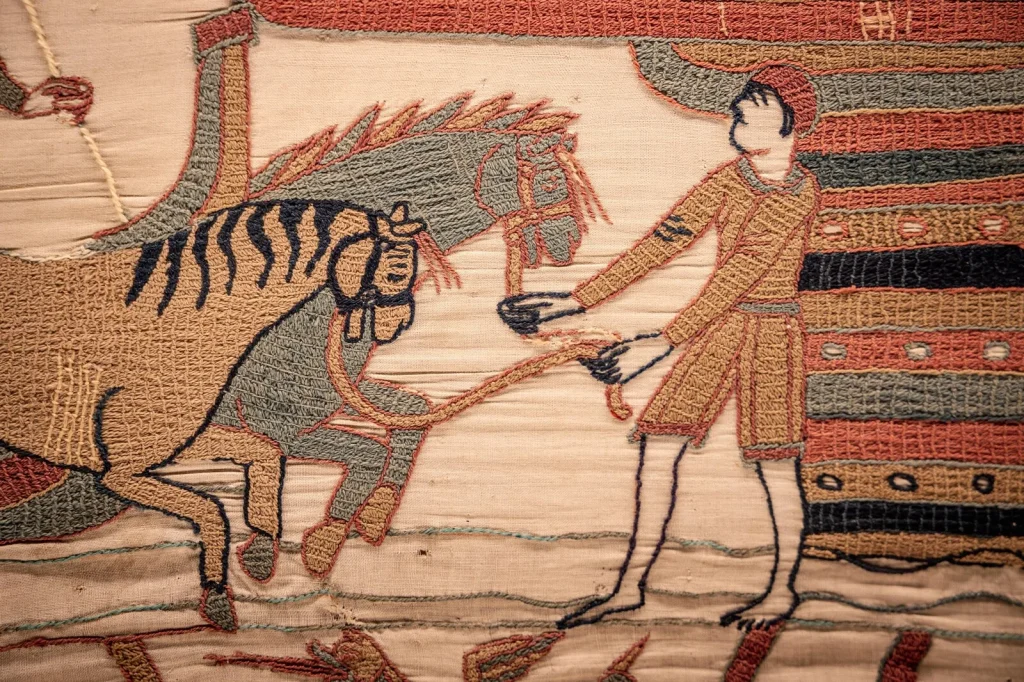
The story it tells spans just a few decisive months: the promise Harold made to William, his betrayal, the military preparations on the Normandy coast, the crossing of the English Channel, and finally the Battle of Hastings, fought on 14 October 1066. This was followed by the coronation at Westminster on Christmas Day and a reign that would bring lasting change to both sides of the Channel.
For children, this is often the part that makes the biggest impression. The Tapestry works like an 11th-century comic strip: you follow the characters from one scene to the next, decipher the Latin inscriptions, spot the horses, the ships, and Halley’s Comet streaking across the sky in April 1066 – an omen, at the time, of the upheaval to come.
Since 1 September 2025, the Bayeux Tapestry Museum has been closed to the public for renovation work. It will reopen in October 2027. The Tapestry will not be on display during this period. It will be on loan to the British Museum for a few months whilst the new exhibition space in Bayeux is being built.
