

Sword Beach was part of the Franco-British sector during the D-Day landings. The name “Sword” was a codename chosen by the Allies for this stretch of coastline. The beach itself is located within the communes of Hermanville-sur-Mer and Colleville-Montgomery, previously known as Colleville-sur-Orne in Calvados. This historical beach invites visitors to explore its profound historical significance and connect with the stories of bravery that shaped the course of history.
The assaut on Sword Beach
Initially, the landing sector designated by the Allies was set to conclude at Courseulles-sur-Mer in the east. However, General Eisenhower and Field Marshal Montgomery successfully argued for an extension to the Orne River, which led to the establishment of Sword Beach. This critical stretch of coastline, situated to the east of Juno Beach, was intended to stretch from Langrune to Ouistreham. Given the formidable German defences at Ouistreham and the treacherous coastal reefs that rendered landings at Lion-sur-Mer and Luc-sur-Mer impractical, the assault would ultimately take place along a relatively narrow front.
At Hermanville-sur-Mer, the British 3rd Division, under the command of General Rennie, made its landing, supported by specially equipped tanks designed for the task. Flanking the division were the elite “green berets” of two commando brigades. To the east, the 1st Brigade, led by Lord Lovat, had the mission of securing Colleville before pivoting left to flank Ouistreham. This brigade notably included 177 French fusiliers-marins under the command of Lieutenant Philippe Kieffer, a testament to the international cooperation of the Allied forces. Meanwhile, at the western edge of the sector, the 4th Brigade was tasked with advancing inland to capture Lion-sur-Mer and Luc-sur-Mer, thereby solidifying the beachhead and paving the way for further advances into occupied France.

What to visit in the Franco-British sector of Sword Beach?
01
Musée Mémorial Pegasus
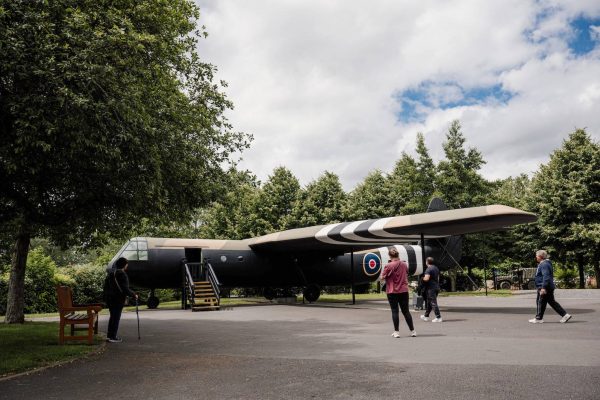
At Ranville, this site showcases the missions of the 6th British Airborne Division during the D-Day landings and the Battle of Normandy. Notably, visitors can see a life-size replica of the Horsa glider.
02
Museum of the Merville Battery
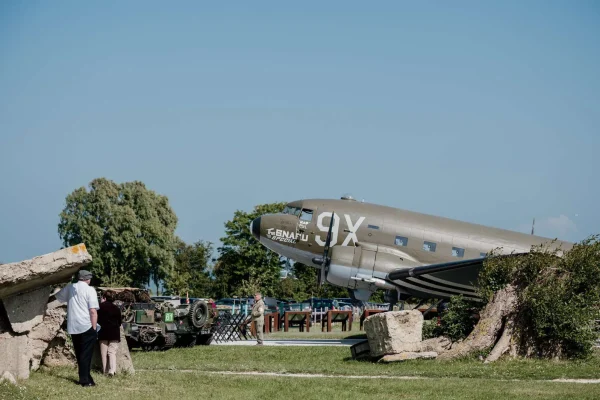
The Merville Battery is a key installation of the Atlantic Wall, commemorating the role of the 6th Airborne Division during the D-Day landings. Located near Merville-Franceville-Plage, the museum features bunkers that have been transformed into exhibition spaces, showcasing a range of historical artifacts, photographs, and multimedia presentations that illuminate the challenges faced by the paratroopers who landed in the area. Notably, visitors can also see an authentic Douglas C-47 aircraft that participated in the D-Day operations, along with preserved bunkers and fortifications that provide a deeper understanding of the military operations during this pivotal moment in history.
03
Site Fortifié Hillman
Located on the southern exit of the town on the road to Biéville-Beuville, this 24 hectare site, comprised of 18 casemates and underground fortifications built by the Germans between 1942 and 1944, was the command post of the German defences along the Côte de Nacre coast. Memorial to the 1st Battalion, Suffolk Regiment, which liberated…
More information
04
Station Radar 44
Radar Station 44: a different perspective on the D-Day landings! Enjoy a timeless experience at a memorial site that is truly one of a kind. Housed in the former German ‘Distelfink’ detection station, Radar Station 44 invites you to discover the hidden side of the D-Day landings: that of technology and detection. This unique site…
More information
05
Atlantic Wall Museum – The Grand Bunker
Established inside a former Atlantic Wall firing command post, this museum presents a reproduction of what the post looked like back in 1944. On the top level, the telemetry post overlooks the entire Orne estuary. Unaccompanied tour time: 1h15.
More information
Useful information for your trip

Save up on attractions with the Explore Normandy Pass
Visit more and spend less with the Explore Normandy Pass! Gain free access to exclusive content and, for just €1, enjoy exceptional discounts at over 70 sites and museums dedicated to D-Day in Normandy.
Frequently Asked Questions
Why the name Sword Beach?
This sector of the Landing was initially to be called ‘Swordfish’, which rhymed with Jellyfish (now Juno) and Goldfish (now Gold). But the Allies finally opted for a shorter code name: ‘Sword’.
Who landed on Sword Beach?
28,845 men landed on Sword Beach on the morning of 6 June 1944 at 7.20am.
What is the nearest major city to Sword Beach?
Sword Beach is the most easterly of the 5 D-Day landing beaches. It is located in Calvados, near Ouistreham. The nearest major town in Normandy is Caen, which is easily accessible by train.